The Future of Patient Onboarding: Key Lessons from Consumer Apps
Mobile technology’s explosive growth continues to transform patient onboarding in healthcare. Smartphone users worldwide now number in the tens of billions, and adults spend almost three hours daily on their devices. The global m-health market has grown from US$ 62.7 billion in 2023, and is projected to reach US$ 158.3 billion by 2030 (CAGR 14.1% between 2024–2030).
Yet healthcare’s patient-onboarding processes lag behind. Even though 81% of physicians use smartphones or tablets, many users of healthcare systems don’t get the smooth experience they’ve grown accustomed to with consumer apps. This is one area where consumer-brand UX and product teams offer valuable lessons—70% of them say personalization is their top priority.
Better patient onboarding should aim to match the convenience users now expect from their digital experiences—something many health-tech companies and providers are still struggling to achieve.
Over the course of this article, we’ll explore the future of patient onboarding and show what UX lessons health tech companies and providers can learn from consumer apps.

The Problem with Traditional Patient Onboarding: A Case for Better UX
Traditional patient onboarding too often feels stuck in the past: clipboards, redundant paperwork, long phone calls. Healthcare facilities still lean on outdated administrative processes that frustrate patients and burden staff—even as medical procedures and diagnostics have advanced. This mismatch creates major hurdles for organizations that want to deliver quality care while meeting modern expectations.
Why Forms and Phone Calls No Longer Work
The non-digital onboarding process involves too much manual work and paperwork, creating many system loopholes. Digital patient intake forms can transform this experience by streamlining data collection and eliminating redundant paperwork. Patients often fill out similar forms again and again, which leads to delays and frustration. Staff then spend time re-entering data into disconnected systems—multiplying errors and inefficiencies.
Manual insurance-eligibility and benefits checks often take too long. Mistakes here can result in claim denials and unhappy patients. The layered dependence on staff and systems makes onboarding slow and messy.
The biggest problem lies in compliance risk: manual processes increase chances of privacy breaches and make it harder to follow regulations such as HIPAA. Patient access suffers because onboarding quality becomes variable—depending on staff, department, or location—without standardized processes.
External sources confirm that poor digital onboarding is a strong signal of broader system issues in healthcare.
Patient Expectations Shaped by Consumer Tech
Today’s patients have very high standards for customer satisfaction. They compare their healthcare experiences to consumer giants. For example:
- Amazon delivers packages rapidly to people’s doorsteps
- Apple support staff deliver attentive, knowledgeable service
Healthcare experiences are getting better, yes—but companies like Amazon and Apple keep raising the bar. Healthcare’s slow pace of improvement makes the gap between healthcare experiences and retail/consumer experiences even wider.
Here are real-life examples of the gap: imagine a patient tries to call a provider’s office during their lunch break, only to hear “we’re closed for lunch.” Or they send a message via a provider portal and are promised a reply “within 2–3 business days.”
Here’s today’s reality: 90% of patients would rather get text reminders than phone calls—yet many clinics still rely on old communication systems. Modern patient engagement tools can bridge this gap by delivering automated, timely communications that meet patient expectations.
The Cost of Poor Onboarding Experiences
Poor onboarding hits the bottom line hard. A single missed appointment can cost practices between $150–$300 in lost revenue. Clinics with 20 monthly no-shows may lose up to $72,000 each year. Without automated reminders, no-show rates can reach 20–30%—which means lost money, wasted staff time, and delayed patient care.
But the effects go beyond money—they tie into patient outcomes and staff retention. New employees may look elsewhere when they feel overwhelmed or unprepared due to poor onboarding. Medical staff and nurses often decide to leave within their first month, sometimes even their first week. Staff turnover costs can run 1.5–3× the employee’s salary. High turnover risks patient safety (because temporary or new hires may not know facility-specific protocols) and patient satisfaction drops sharply as turnover increases.
These heavy administrative burdens steal precious time from what healthcare providers care about most—patient care.
In short: traditional onboarding processes demand too much manpower for data structuring and mapping, pulling resources away from healthcare’s core mission: helping patients heal.

mobile healthcare apps
What Consumer Apps Get Right (And What Health-Tech Companies Can Learn)
Consumer apps excel at creating smooth digital experiences. Healthcare organizations can learn a lot from their approach. Tech companies know first impressions count—they invest in building smooth entry points that turn casual users into loyal customers.
Here are some key components consumer apps get right, which are directly applicable to patient onboarding:
Frictionless Sign-Ups and Smart Defaults
The best apps keep original signup forms simple. That reduces dropout rates before completion. Users often only need basic details (e.g., name, email) instead of long form-filling. Smart defaults and step-by-step profiling make onboarding feel like a conversation rather than an interrogation.
Social-login (sign-in via accounts users already have) adds convenience and improves accuracy—since users don’t need to type everything manually. Apps ensure the experience works well on mobile devices (since more than half of internet usage happens on phones). Good interfaces adapt naturally to different screen sizes so the experience stays consistent no matter what device a person uses.
Personalized Onboarding from the Start
Great apps understand each user is unique. They don’t simply give everyone the same generic intro. Short surveys collect just enough info to build meaningful user segments or paths.
Tailored onboarding boosts activation significantly. Studies show improving activation by just 25% can increase monthly recurring revenue by ~34.3%. Top consumer apps customize welcome flows and feature introductions so each user sees what matters most to them.
Instant Value Delivery and Feedback Loops
Consumers want quick results. The best apps show value almost immediately—they demonstrate how the product solves a specific problem before asking for more information. These “aha moments” build user confidence.
Getting feedback early matters—not just later. Early feedback does three things: shows users their opinions matter, helps fix problems quickly, and builds lasting relationships. In healthcare contexts, organizations that listen and respond during onboarding create stronger loyalty.
Trust-Building Through Transparency
Top apps are open about their data practices. They clearly tell users what information they collect and how it will be used. That openness builds trust—something that matters more than ever in a data-driven world. Good apps explain data collection at the right moments, using short, relevant in-app messages—not burying it in legal jargon.
Users now expect control over their personal information. In healthcare, transparency isn’t just “nice to have”—it’s essential.
In summary: There are clear lessons health-tech and provider organizations can learn from consumer apps. Smooth entry points, tailored experiences, quick value delivery, and open data practices can transform patient onboarding from a pain point into a genuine positive introduction. The result? An experience that meets modern expectations, instead of testing patients’ patience.
Applying Consumer Lessons to Healthcare Onboarding
Healthcare providers now understand that user-focused design isn’t optional—it’s vital for better patient outcomes. Smart consumer-app strategies can reshape the future of patient onboarding from frustration to smoothness.
Here’s how you can apply these lessons to your health-tech onboarding experience:
Designing for Low Effort and High Clarity
Patients often abandon onboarding because they feel confused or overwhelmed. Smart organizations make things easier by:
- Using address autocomplete and prefilling information where possible
- Adding example text in form fields (so patients know exactly what to enter)
- Providing clear instructions—via pictures or videos—for tasks like ID verification
- Asking only for must-have information upfront to keep patients engaged
According to research, 60% of potential users skip healthcare-app installation after seeing how much personal data they must share. AI-powered patient intake solutions can streamline this process by automating data collection and reducing the information burden on patients.
Using Data to Personalize Onboarding
Learning-based onboarding works better than “let users figure it out themselves.” Providers can spot knowledge gaps and deliver the right content based on user needs. For example, in clinical settings, adaptive learning helps staff master new systems faster.
Progressive risk-segmentation allows smart flows that adjust security based on a user’s risk level: low-risk users get fewer steps, while higher-risk pathways maintain proper controls.
Embedding Referral and Intake Logic
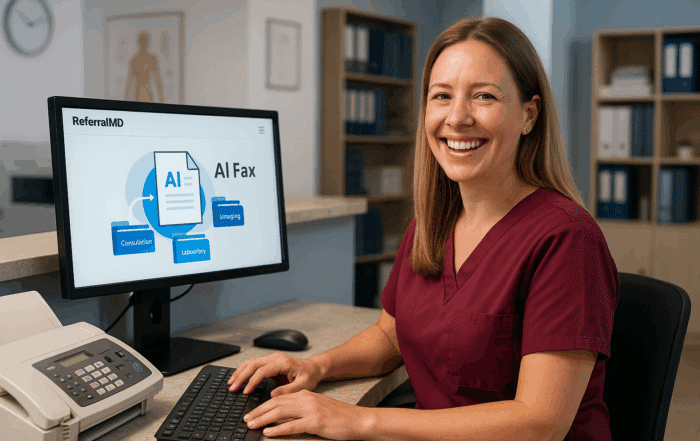
Companies like ReferralMD show how smart referral management can improve onboarding. Referral management software tracks referrals from intake through approval and updates—eliminating the classic “lost fax / phone call to insurance” gap.
Providers can submit and track approvals electronically in one place, while the system communicates with patients via their preferred channel—phone, email, or SMS—about appointments, paperwork, and follow-ups. This level of end-to-end referral coordination ensures nothing falls through the cracks.
Gamification and Chatbot Support
Gamification can make patients more engaged: research points to five game-design areas that improve onboarding—achievement, challenge, guidance, fun, and social bonds. Clear goals with progress tracking help motivate patients. Some onboarding apps reward points early and explain why the “game” helps them.
AI chatbots serve as digital helpers during onboarding: they answer questions instantly, guide patients step-by-step, collect information efficiently, and reduce confusion. Some patients find it easier to share sensitive information with a chatbot rather than a person.

5 Key Tech Trends Redefining the Future of Onboarding
Technology is changing patient onboarding in healthcare faster than ever. Providers now offer smarter, quicker, and more secure experiences. These breakthroughs help merge clinical excellence with consumer-friendly convenience.
1. AI-Driven Onboarding Assistants
Smart chatbots now guide patients through onboarding with dynamic questions that adapt based on answers. These AI helpers can check responses in real time and switch methods if patients need help. For example, systems like Azure AI are used behind the scenes to extract details from documents and map them appropriately in healthcare systems.
The healthcare chatbot market is projected to grow from US$ 248 million in 2022 to US$ 11.79 billion by 2030, reflecting the massive opportunity for healthcare organizations to leverage conversational AI for better patient experiences.
2. Biometric Verification and Digital IDs
Healthcare biometrics are projected to reach US$ 14.50 billion by 2025, growing 23% annually. Facial recognition has become a core method for remote ID verification—used to stop fraud and improve security. One provider we worked with saw app downloads jump 312% after adding biometric checks.
3. APIs and Data Portability Across Systems
Modern healthcare APIs now make it easier to locate patient data across medical databases nationwide. Advanced solutions can access data for ~85% of patients, with ~95 documents per person being consolidated—reducing duplicate paperwork. For instance, in Estonia, 99% of health data is digital and available to both doctors and patients.
Integrated referral management systems leverage these APIs to create seamless data flows between primary care providers, specialists, and patients—eliminating manual data entry and reducing errors.
4. Telehealth-First Onboarding Experiences
Telehealth use has surged (roughly 38× compared to pre-pandemic levels). Modern telehealth platforms emphasize simple onboarding—with features like closed captions, keyboard controls, multiple languages, and built-in system checks. The onboarding process is now part of the telehealth experience—not just the visit.
5. Inclusive and Accessible UX Design
AI now enables tailored accessibility beyond basic compliance. Some systems simplify medical terms based on a user’s comprehension level. Good design includes:
- Short, active sentences (15–20 words)
- “You-focused” microcopy (rather than jargon)
- Simple numbers instead of complex words
- Video explanations for harder concepts
- A seamless transition between different user flows and UX elements
Ensuring accessibility isn’t just ethical—it’s smart business.
Why Better Onboarding Is a Business Imperative
Modern patient onboarding delivers measurable returns—it’s a business necessity, not just a technology upgrade. Organizations that onboard newcomers (patients or staff) effectively see 2.5× greater revenue growth and 1.9× higher profit margins compared to those that don’t.
Here’s why better patient onboarding matters from a business perspective:
Higher Patient Satisfaction and Loyalty
When patients feel in control of their care experience—with a smooth onboarding process that creates a positive first impression—the foundation for long-term care relationships is built. Trust becomes a key predictor of patient loyalty.
Research shows private centers with optimized onboarding reported substantially higher patient satisfaction (around 73%) compared to public facilities (~52%). This satisfaction helps reduce patient turnover costs and improves retention.
Patient engagement strategies that prioritize digital communication and convenience can dramatically improve loyalty—79% of patients are more likely to select a provider who allows them to conduct healthcare interactions online.
Reduced Operational Costs
Digital onboarding significantly cuts administrative work. Staff spend less time distributing forms, re-entering data, or confirming appointments manually. Digital data entry reduces transcription errors, leading to faster claims processing and reimbursements.
AI-powered fax management and automated referral processing can eliminate hours of manual work, allowing staff to focus on high-value patient care activities rather than administrative tasks.
Improved Clinical Outcomes Through Better Involvement
Quality communication at the start matters. Clear onboarding helps patients understand their treatment plans, which boosts adherence and reduces readmissions. Patients who are engaged from the beginning make better long-term health choices and detect potential problems earlier—benefiting both health outcomes and organizational performance.
Effective referral best practices ensure that patients receive timely, coordinated care from the right specialists—reducing delays and improving outcomes across the care continuum.
Closing Thoughts
The future of patient onboarding in healthcare combines clinical excellence with consumer-grade convenience. Healthcare providers and tech companies must close the experience-gap between medical care and the consumer world. They can achieve this through:
- Smooth, low-friction design principles
- Personalized onboarding strategies
- Quick value delivery (“show me the benefit now”)
- Transparent data and privacy practices
- Leveraging technology—AI assistants, biometrics, data integration
The advantages are clear: patients are happier, costs go down, outcomes improve.
Healthcare and health-tech organizations that embrace these new ideas won’t just survive—they will excel in an increasingly competitive environment. Most importantly, they will deliver what patients need most: exceptional care right from their first visit.
Ready to transform your patient onboarding experience? Discover how ReferralMD’s integrated platform can help you automate workflows, improve patient communication, and deliver the seamless digital experience today’s patients expect.
Related Posts



Subscribe to Our Blog
Recent Posts