Automated texting, email notifications, appointment reminders, digital intake, patient scheduling portals, and Voice AI scheduling can connect patient communication to referral management. Platforms such as ReferralMD, Luma Health, and Phreesia offer communication capabilities within their own referral workflows. Connecting a separate communication product to an existing referral system requires confirmation of the specific integration and supported actions.
For referral coordinators and patient access teams, the goal is practical: help patients understand the next step, schedule their visit, and stay connected without requiring staff to make every call manually.
The most useful question is whether communication actually moves the referral forward.
Why Patient Communication Needs to Connect to Referral Status
An appointment reminder helps after a visit is booked. An unscheduled referral needs a different response: a scheduling invitation, a request for missing information, or outreach from staff.
If communication operates separately from referral tracking, staff may need to reconcile messages, responses, and appointments across multiple screens. A connected workflow should help the team answer:
- Has the patient been contacted?
- Is the referral ready to schedule?
- Did the patient book, decline, or request help?
- What is preventing the next step?
- Who owns the follow-up?
These questions make referral progress a better measure of success than message volume alone.
Which Types of Automated Communication Tools Support Referral Workflows?
The following table describes capabilities to evaluate. Availability depends on the product, configuration, and integration.
| Tool category | Referral use case | Integration capability to verify |
|---|---|---|
| Automated SMS and email | Send referral acknowledgments, scheduling instructions, and follow-up prompts. | Messages triggered by the relevant referral status. |
| Appointment reminders and confirmations | Help patients confirm and prepare for scheduled visits. | Confirmation or cancellation outcomes returned to the appropriate system. |
| Patient scheduling portals | Give referred patients a direct path to book or request an appointment. | Correct availability, visit rules, and appointment-to-referral matching. |
| Digital or conversational intake | Collect information needed before a visit. | Completed intake linked to the correct patient and workflow. |
| Voice AI scheduling | Conduct scheduling conversations by phone. | Live availability, scheduling rules, and direct appointment booking. |
| Two-way messaging | Let patients ask questions or report scheduling barriers. | Responses routed to a responsible team, with a visible history. |
Examples of Platforms With Connected Referral Communication
ReferralMD: Workflow-Based Texts, Emails, and Voice AI Scheduling
ReferralMD Patient Communications supports automated text and email messages triggered by workflow updates. Teams can configure appointment instructions when a referral is ordered or an appointment is scheduled, customize reminder templates, and receive notifications about patient confirmations.
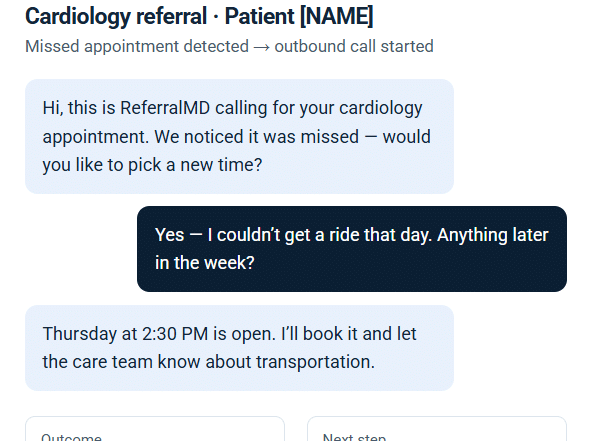
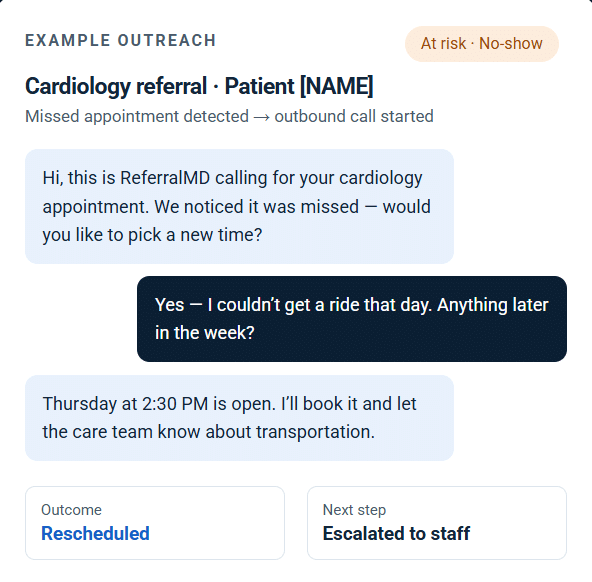
ReferralMD’s Voice AI Scheduling Agent adds inbound and outbound phone conversations. It verifies patient identity, captures the reason for the visit, checks real-time availability, applies organization-defined scheduling rules, and books directly into an integrated EHR, practice management system, or scheduler. It also supports multilingual conversations.
This gives organizations options for communicating through both written messages and phone-based scheduling within the broader referral platform. Confirm the supported functions for your EHR and workflow during implementation.
Luma Health: Referral Outreach and Patient Engagement
Luma Health describes EHR-connected referral status updates, scheduling outreach, and automated follow-up. Its patient engagement offering also includes interactive reminders that can update the EHR when patients confirm or cancel appointments.
During evaluation, ask which referral events trigger outreach and how scheduling outcomes return to your existing workflow.
Phreesia: Referral Management With Patient Texting
Phreesia’s referral management platform combines referral queues, PM/EHR integration, and patient texting to confirm information and request documents. It also describes configurable text reminder cadences and bidirectional EHR integration.
Confirm whether the proposed configuration supports your organization’s scheduling and referral follow-up requirements.
These examples describe each vendor’s own offerings. They do not establish that Luma Health or Phreesia has a native connector to ReferralMD, or that every communication feature works with every EHR.
What Does “Integrates” Actually Mean?
A product can integrate at several levels. Receiving a patient contact list is different from reading referral status, booking an appointment, or updating the referral record.
Ask vendors to demonstrate three parts of the connection:
- Trigger: What event starts communication—referral receipt, readiness to schedule, or an appointment change?
- Action: Can the patient confirm, provide information, request help, or complete booking?
- Result: Where is the outcome recorded, and what happens next?
For example, a patient who books should leave the unscheduled outreach queue. A patient who reports a transportation barrier should reach a team member who can help. Ask for both scenarios in the demonstration.
How to Evaluate a Tool Before Adding It
Use a realistic test referral to check the complete workflow:
- System compatibility: Verify your exact EHR, practice management system, and referral platform.
- Scheduling accuracy: Check appointment types, locations, providers, and eligibility rules.
- Outcome visibility: Confirm that staff can distinguish attempted outreach, a delivered message, a response, and a booked appointment.
- Exception handling: Test failed delivery, no response, a cancellation, and a request for staff assistance.
- Patient preferences: Review channel choice, language support, and communication preference handling.
- Workflow ownership: Determine who receives unresolved tasks and how duplicate outreach is prevented.
Then measure referral-to-scheduling time, the share of eligible referrals that become appointments, completed visits, and staff follow-up workload. Report each outcome separately: a scheduled appointment does not confirm that the visit occurred.
Frequently Asked Questions
Can automated patient communication tools work with an existing referral system?
Yes, when a supported connection can exchange the required data and actions. Ask the vendor to verify your specific system and show referral-triggered outreach and outcome recording.
Are appointment reminders enough to manage referral communication?
Reminders address scheduled visits. Referral communication also needs to address patients who have not booked, incomplete information, unsuccessful outreach, and requests for help.
Can Voice AI book referred patients directly into an EHR?
ReferralMD’s Voice AI Scheduling Agent supports direct booking into integrated EHR, practice management, and scheduling systems. The supported scheduling functions depend on the configured connection.
Does an EHR integration automatically update referral status?
Not necessarily. Confirm whether the connection updates appointments, referral records, communication history, or all three. Ask how the system matches a booked appointment to the originating referral.
Connect Communication to the Next Step in Care
Start with the point where your referrals stall. If patients are waiting for scheduling calls, evaluate automated outreach and booking. If staff are chasing missing information, evaluate intake and messaging. If patients book but miss visits, review reminders and follow-up.
See how ReferralMD connects patient communication with referral workflows. Schedule a demo to explore automated messaging, Voice AI scheduling, and integration options for your organization.
Related Posts
Subscribe to Our Blog
Recent Posts