How can a small practice improve referral management affordably? Use one shared system to track referrals, assign the next action, and follow up until an outcome is documented. Start with core referral tracking, then add paid automation for time-consuming tasks such as fax processing or patient outreach when the expected benefit justifies the cost.
A referral arrives by fax. Someone checks for missing information, enters patient details, and calls to schedule. The patient misses the call. The referring office asks for an update. By the end of the day, several people have worked on the same referral, but the appointment still isn’t booked.
For an independent practice, improving that process has to fit the budget, the staffing model, and the way referral partners already work.
Affordable referral management starts with a shared record of every referral, a clear owner for the next step, and a reliable way to follow through. Once those basics are in place, practices can add automation where it removes the most repetitive work.
What is referral management for a medical practice?
Referral management is the process of organizing, routing, tracking, and following up on patient referrals between care teams. It includes identifying missing information, supporting scheduling, recording outcomes, and returning relevant information to the referring clinician. Practices sending referrals and practices receiving them need visibility into different parts of this process.
Why does closing the referral loop matter?
Sending a document confirms that information has left one office. It does not establish whether the receiving team accepted the referral, contacted the patient, scheduled a visit, or returned the consultation report.
The Institute for Healthcare Improvement’s guide to safer ambulatory referrals describes a nine-step process for closing the referral loop. It identifies unclear responsibilities and communication breakdowns as sources of referral problems, even when organizations use electronic health records.
For practices, the practical lesson is to track what happens after the handoff. Scheduling is an important milestone; a closed referral loop also requires the appropriate outcome information to reach the responsible care team.
What makes manual referral coordination expensive?
Manual referral costs come from staff time spent entering data, contacting patients, obtaining missing records, and checking status. A spreadsheet may have little direct cost, but maintaining it takes time. Staff still need to reconcile it with fax folders, appointment schedules, phone messages, and the medical record.
Before evaluating software, follow a small sample of referrals through your current process. Record where staff retype information, search for updates, repeat outreach, or wait for another office to respond.
Estimate the labor involved using your own data: referrals per month multiplied by average administrative minutes per referral, divided by 60, multiplied by the loaded hourly staff cost. This is a planning estimate, not a promise that every minute can be eliminated.
The review should reveal a specific first priority, such as reducing duplicate entry or identifying referrals that have not moved forward.
How do you build a consistent referral workflow?
A consistent referral workflow needs defined statuses, an owner for each next step, and a follow-up deadline. Start with a manageable set of statuses: received, missing information, ready for scheduling, patient contacted, scheduled, visit completed, and report returned. Document other outcomes separately, including patient declined, redirected, or unable to reach after the practice’s follow-up process.
For each status, define who owns the next action and when the team should review an unresolved referral. Use clinician-approved urgency rules so time-sensitive referrals receive appropriate attention.
A shared workflow also makes coverage easier. When a coordinator is out, another team member should be able to see what happened, what remains outstanding, and who needs to act.
How can practices make referral follow-up easier?
Referral coordination depends on what happens outside your office, too. A referring practice needs to know which records to send. A patient needs to understand why the appointment matters and how to arrange it.
AHRQ’s Make Referrals Easy guidance recommends establishing expectations with referral partners, helping patients arrange appointments, addressing barriers such as transportation and language needs, and tracking whether referrals were completed.
Put those principles into everyday operations:
- Agree on referral requirements. Share the information your practice needs to accept and schedule a referral.
- Explain the scheduling process. Tell patients who will contact them, how to respond, and whom to call for help.
- Keep communication connected. Record outreach attempts and status updates with the referral so staff can see the history.
- Investigate stalled referrals. A patient may need help with cost, transportation, availability, or understanding the instructions.
Software can help teams organize that work. Clear expectations between people remain essential.
Which referral tasks should a practice automate?
Practices do not need to activate every available feature at once. Choose a recurring task, establish a baseline, and evaluate whether automation makes the task easier without creating new review work elsewhere.
| Recurring problem | Capability to evaluate | What to verify |
|---|---|---|
| Staff retype information from faxes | AI fax extraction and routing | How extracted fields are reviewed and uncertain information is flagged |
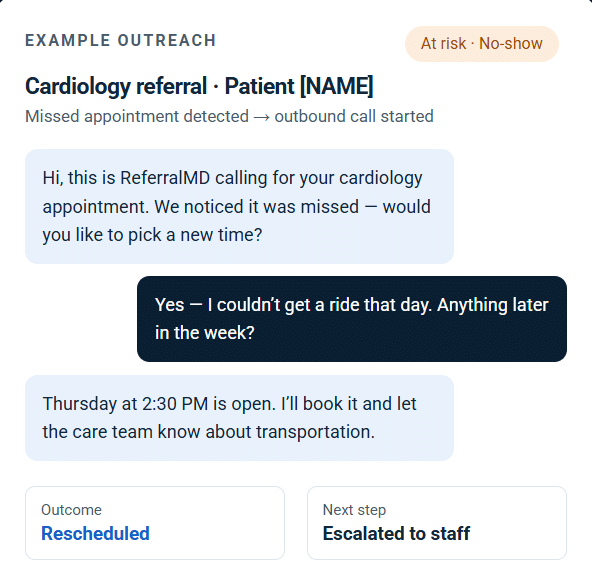
| Patients are difficult to reach | Text outreach or Voice AI scheduling | How responses, unsuccessful contacts, and requests for staff help are handled |
| Incomplete forms delay scheduling | Digital patient intake | How missing answers are identified and patients receive help |
| Referrals sit without follow-up | Workflow alerts and task assignment | Whether alerts identify an owner and a useful next action |
| Staff enter bookings in multiple systems | EHR scheduling integration | Whether it supports deep EHR scheduling write-back for the actual EHR or scheduling system |
Be specific about scheduling capabilities. Sending a booking link, requesting an appointment, and completing a booking directly in an EHR are different functions. Ask vendors to demonstrate the workflow your practice needs, including what happens when a booking cannot be completed.
What should free referral management software include?
Look for shared referral tracking, team access, configurable statuses, task ownership, alerts, and reporting. A free core platform can give practices a way to organize referrals before committing to additional services. The important question is whether the included capabilities solve the immediate problem and what costs arise as usage grows.
Compare user limits, workflow features, reporting, onboarding, support, and the ability to export your information. Ask which services carry usage charges, recurring fees, or separate integration costs. Model those costs against realistic fax volumes, message segments, intake forms, and voice minutes.
ReferralMD provides one example of this approach. Its free referral management offering for practices includes unlimited users, configurable workflows, provider CRM, scheduling tools, and analytics. Practices can add services such as fax processing, digital intake, texting, and Voice AI; advanced EHR integrations are available through enterprise offerings.
In its adoption update, ReferralMD reported that registrations for its free solution increased 118%, active users increased 115%, and weekly referral volume for free accounts increased 157% between September 7 and October 26, 2026. These company-reported figures describe platform adoption and usage during that period; they are not measures of referral completion or patient outcomes.
Which referral management metrics should you track?
Track time to outreach, unresolved referral age, scheduling conversion, visit completion, and report return. More referrals do not necessarily mean more patients are receiving care. Track a few measures that show where referrals advance and where they stall:
- Time to first outreach: How long patients wait before the first contact attempt.
- Unresolved referral age: How long referrals remain open at each stage.
- Scheduling conversion: The share of an agreed referral cohort that results in a booked appointment.
- Visit completion: Whether scheduled patients attended, canceled, or did not show.
- Report return: Whether the referring care team received the consultation information.
Report return also has a place in formal quality measurement. The CMS Closing the Referral Loop measure evaluates whether the referring clinician receives a report from the clinician to whom the patient was referred. Practices using that measure should follow its full specifications rather than substitute a general scheduling metric.
Referral analytics and reporting can help teams compare these stages and identify where referrals stop advancing.
Define the date range, denominator, and exclusions for each measure. Keep bookings separate from completed visits, and record why referrals end without an appointment. That distinction helps teams understand where additional outreach or a different process may help.
How can a practice get started without a major rollout?
Choose one referral source, provider, or intake queue for the initial rollout. Assign an owner, agree on statuses, and record baseline performance before changing the process.
Review unresolved referrals with the team, gather feedback, and adjust the workflow before adding more automation. This gives a practice a practical way to learn what works while keeping implementation manageable.
The goal is a process in which staff can quickly see what happened to a referral and patients receive help taking the next step.
Frequently asked questions about affordable referral management
Is there free referral management software for small practices?
Yes. ReferralMD offers core referral management with unlimited users and no monthly platform cost. Optional services such as fax, AI processing, digital intake, texting, and Voice AI have separate charges. Check the current pricing and integration requirements before choosing a configuration.
What is closed-loop referral management?
Closed-loop referral management tracks a referral through its outcome and communicates the appropriate information back to the responsible care team. For a completed specialist visit, that includes returning and reviewing the consultation information and following through with the patient as appropriate.
Can a practice improve referral management without replacing its EHR?
Yes. A practice can improve ownership, tracking, and follow-up while retaining its EHR. A separate referral management platform may support that work, but practices should verify how information moves between systems and which steps require integration.
Does free referral management mean every automation feature is free?
No. Included features and pricing vary by vendor. A free platform may charge separately for fax, AI processing, texting, voice services, integrations, or other capabilities. Review the current terms and estimate costs using your expected activity.
Is a scheduled appointment the same as a completed referral?
No. Scheduling confirms a booking. Referral completion requires documenting what happened afterward and communicating relevant information to the responsible care team. For a specialist visit, that includes the consultation report; other outcomes, such as a patient declining the referral, should also be documented.
Which referral task should a small practice automate first?
Start with a frequent, measurable task that consumes substantial staff time, such as fax data entry or routine patient outreach. Define how staff will review exceptions, then compare results with the previous process before expanding.
Start with free referral management
ReferralMD gives practices a free starting point for organizing referrals, coordinating team tasks, and tracking progress, with additional automation available as needs grow.
Start Now to explore free referral management with unlimited users and no monthly platform cost. Review current pricing for optional paid services.
Related Posts


Subscribe to Our Blog
Recent Posts