The Digital Front Door Is Open — But the Back Office Is Lagging
A Mordor Intelligence report predicts that the digital front door market size will surge from USD 31.66 billion in 2026 to USD 82.25 billion by 2031, reflecting strong momentum in consumer-grade scheduling, virtual visits, triage, pricing, and payments. At the same time, the global patient referral management software market reached $16.14 billion in 2025 and is projected to expand to $67.92 billion by 2034 — underscoring how central referral coordination has become to healthcare operations.
But here’s the catch. While healthcare organizations have invested significantly in clinical systems, digital front doors, patient portals, scheduling tools, and back-office platforms, patients and care teams still face delays due to disconnects between workflows. The truth is that lack of technology is not the biggest gap — it is the lack of connected execution between bedside and back-office operations. Trusted and better patient outcomes, scalable innovation, and cost-efficiency must come together in a holistic continuum now and here.

What Does “Bedside to Back Office” Mean in Healthcare?
“Bedside to back office” refers to the seamless connection between clinical care decisions — such as placing a referral or writing a discharge plan — and the administrative and operational workflows that execute them, including scheduling, prior authorization, documentation, billing readiness, and patient communication. When these two sides are not synchronized, the result is care delays, referral leakage, revenue loss, and frustrated patients and providers.
A 2025 McKinsey Physician Survey reveals that access barriers comprised three of the top five reasons why patients postponed care. The reason is that a referral is not just a clinical request; it triggers scheduling, documentation, authorization, communication, and financial workflows. Unless the processes of intake, referral routing, scheduling, and specialist availability are efficiently connected to the administrative workflows of eligibility, prior authorization, documentation, and billing readiness, the result will be poorer outcomes and frustrated patients and physicians.
The same may be said of discharge plans. They are not complete unless follow-up care, patient communication, medication, and administrative readiness are well aligned.
The “bedside-to-back-office” model aims to achieve this handshake. It starts from the realization that a digital front door may create access — but connected back-office execution is what determines whether that access will result in timely care. It demands that operational workflows (staffing, capacity, procurement, supply chain, finance, and reporting) demonstrate diligent last-mile connectivity to patient engagement workflows (reminders, education, follow-up updates, and communication). And it understands that clinical and administrative transformation can no longer be treated as separate programs.
The True Cost of Disconnected Healthcare Workflows
Disconnected systems create measurable, quantifiable damage across the care continuum. Healthcare systems currently lose 10–30% of annual revenue to referral leakage — translating to $821,000 to $971,000 in downstream revenue loss per physician annually. At the health system level, the average organization loses $388 million per year to referral leakage alone. Meanwhile, 38% of referrals never close the loop, stalling between the referring office and the specialist scheduler.
To understand this better, consider the consequences of disconnected workflows:
- Referral stalls: Referrals may be created, but missing documentation, unclear ownership, limited specialist availability, or delayed follow-up can slow down care — and 68% of leaked referrals originate from integration failures at intake, not from patient non-compliance.
- Authorization gaps: Care teams may know what the patient needs, but administrative teams often receive incomplete information too late — leading to gaps in prior authorization and eligibility that fuel claim denials. In fact, 67% of rejected claims stem from referral or authorization breakdowns.
- Scheduling blind spots: Patients may be ready for the next step, but real-time visibility into provider availability, workforce capacity, or location-level demand is absent.
- Revenue cycle failures upstream: Revenue cycle issues may begin before the claim is ever created, especially when intake, referral, authorization, and documentation workflows are incomplete.
- Communication breakdowns: Patients not knowing what happens next drives higher no-shows, repeat calls, care delays, and referral leakage. Primary care physicians send referral notes 69% of the time — but specialists report receiving them only 34% of the time.
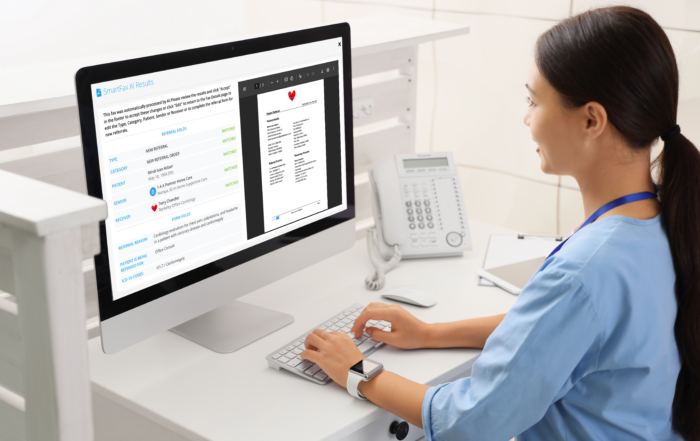
This is where referral management steps in as an effective bridge between care and operations. Positioned at the intersection of clinical decision-making, patient access, and operational execution, a mature referral workflow smoothly synchronizes the referring provider, specialist, patient, scheduler, authorization team, documentation team, and the analytics layer. It plugs the gaps between bedside intent and back-office execution.
Closed-loop referral visibility can reduce leakage, improve care coordination, and support value-based care outcomes. It enables 24/7 self-service for better consumer experiences and increased patient acquisition. It can swiftly respond to queries and potential issues, guiding patients to the next-best actions.
A 5-Layer Operating Model for Connected Care Delivery
Building bedside-to-back-office connectivity is not a single technology project — it is a layered operating model. Here is a structured approach to creating a connected strategy and care journey.
Layer 1: Unified Patient and Referral View
Healthcare teams create a shared operational view of the patient’s journey across intake, referral, scheduling, clinical documentation, authorization, and follow-up. This single source of truth eliminates the information silos that cause handoff failures.
Layer 2: Real-Time Workflow Orchestration
Tasks are routed to the right teams based on referral type, urgency, payer requirements, location, specialist availability, and documentation status — eliminating the manual coordination that bogs down coordinators and delays care.
Layer 3: Connected Clinical and Administrative Data
Clinical, financial, operational, and patient communication data are connected to enhance referral performance. This is the foundation for EHR integration and interoperability — ensuring the right data travels with the referral rather than arriving late or not at all.
Layer 4: Predictive and Operational Analytics
Bottlenecks — referral aging, time-to-schedule, authorization delays, no-show risk, capacity constraints, denial risk, and documentation completeness — are tracked and surfaced as decision-enabling insights. Real-time referral tracking dashboards have been shown to improve referral processing efficiency by up to 45%.
Layer 5: Governance and Accountability
Every referral or care transition is assigned a clear owner, status, next action, and escalation path. Without this layer, even the best technology investments fail to produce reliable outcomes.
Disconnected vs. Connected: A Real-World Scenario
Consider a discharged patient who needs a specialist follow-up, diagnostic test, medication support, and payer authorization.
In a disconnected model: Referrals are sent manually and the patient waits for a call — or repeatedly follows up for status updates. Authorizations are not checked promptly; the specialist has incomplete information; and the revenue cycle team discovers missing documentation after the visit. The patient is left navigating a fragmented system alone.
In a well-connected bedside-to-back-office model: Referrals are created directly from the clinical workflow and required documentation travels with the referral. Eligibility and authorization checks begin earlier; scheduling is aligned to the specialist’s real-time capacity; and the patient automatically receives timely communication and reminders. Finance, operations, and care teams have real-time status visibility — and care is delivered without friction.
This is the operational difference that closed-loop referral management platforms like ReferralMD are designed to deliver — reducing referral processing time by 50%, increasing staff productivity by 11.5%, and cutting cost of care by 15%.

Technology Is One Part of the Answer — Workflow Is the Other
Healthcare transformation is not just about deploying more platforms or tools. It is about designing an operating model centered on connectedness, smart workflow redesign, interoperability, and meticulous data governance. Automating a broken workflow only hastens and scales the inefficiency — so the workflow must be addressed first.
Organizations can achieve this without overwhelming their teams. A practical sequencing:
- Map the referral journey from clinical decision to completed visit; identify the top three handoff failure points.
- Connect intake, referral, scheduling, and communication data first; build a shared dashboard across access, operations, and finance.
- Only after the workflow is clearly understood should automation of repetitive tasks begin.
- Once the access workflow is stable, expand into workforce management, supply chain, revenue cycle, and advanced analytics.
- Establish clear ownership between clinical and administrative teams for every stage of the referral lifecycle.
KPIs That Measure Bedside-to-Back-Office Performance
KPI-driven improvement and continuous optimization are critical. Organizations implementing connected referral workflows should track:
- Referral completion and referral leakage rates
- Average time from referral to appointment
- Referral aging by specialty
- Prior authorization turnaround time
- First-contact-to-appointment conversion
- No-show rate
- Completeness of documentation
- Denial rates linked to intake or referral errors
- Patient communication response rate
- Capacity utilization by location or specialty
- Staff productivity across referral and scheduling teams
Organizations using structured referral coordination have demonstrated a 35% reduction in claim rejections and a 24% improvement in patient satisfaction scores — outcomes that make the business case for connected workflows clear and measurable.
The Future of Healthcare Transformation Is Connected Execution
Patient access, referral management, scheduling, workforce planning, revenue cycle, supply chain, and care coordination are not separate programs — they are all part of the same patient experience. Organizations that connect these workflows will reduce leakage, improve access, strengthen care coordination, and make transformation visible at the point of care.
The technology to fix referrals exists today. What differentiates high-performing health systems is the commitment to connected execution — from the first clinical decision to the last administrative step.
Want to see how ReferralMD closes the loop between bedside and back office? Request a demo or start for free with our Practice tier.
About the Author
Abhishek Gupta is Senior Vice President and Segment Head – Healthcare & Life Sciences at Mastek, with deep experience in healthcare technology consulting, strategy, and digital transformation.
Frequently Asked Questions: Bedside-to-Back-Office Healthcare Connectivity
What does “bedside to back office” mean in healthcare?
“Bedside to back office” describes the connection between clinical workflows — such as placing a referral, scheduling a follow-up, or writing a discharge plan — and the administrative and operational systems that execute them, including prior authorization, billing, documentation, and patient communication. When these two sides are disconnected, care delays, referral leakage, and revenue loss follow.
What is referral leakage and why does it matter?
Referral leakage occurs when patients are referred to a specialist but end up receiving care outside the health system’s network — or never complete the referral at all. This results in 10–30% annual revenue loss for health systems (averaging $388 million per organization) and disrupts care continuity. Closed-loop referral management is the primary tool for reducing leakage by tracking every referral from creation to completed visit.
What is closed-loop referral management?
Closed-loop referral management is a workflow approach — supported by technology — that tracks a referral through every stage: creation, documentation, authorization, scheduling, patient communication, and post-visit follow-up. When the loop is fully closed, both the referring provider and the patient receive confirmation that care was delivered. This approach significantly reduces referral leakage, no-shows, and authorization-related claim denials.
How does referral management connect clinical and administrative workflows?
A mature referral management platform acts as the bridge between clinical decision-making and back-office execution. It routes referrals with complete documentation to the right specialist, triggers eligibility and prior authorization checks at intake, enables real-time scheduling, automates patient communication, and surfaces performance analytics — ensuring that every team from care coordination to revenue cycle has the visibility they need to act.
What KPIs should health systems track for referral workflow performance?
Key performance indicators include referral completion rate, referral leakage rate, average time from referral to appointment, referral aging by specialty, prior authorization turnaround time, no-show rate, documentation completeness, claim denial rates tied to intake errors, and patient communication response rate.
What is the difference between inbound and outbound referral management?
Inbound referral management handles referrals received from other providers — specialists and health systems managing incoming patient requests. Outbound referral management covers referrals sent from a provider to an external specialist or facility. Both require coordination of documentation, scheduling, authorization, and communication. Outbound workflows accounted for 64.53% of the patient referral management market in 2024, driven by health systems’ need to retain visibility and reduce leakage when patients leave the network.
How does prior authorization fit into bedside-to-back-office connectivity?
Prior authorization is one of the most common points of failure in the referral lifecycle. When eligibility and authorization checks are not triggered automatically at intake, authorizations are delayed or missed — causing care delays and claim denials. In a connected bedside-to-back-office model, authorization workflows are initiated as part of the referral creation process, not as an afterthought after scheduling is attempted.
Related Posts


Subscribe to Our Blog
Recent Posts