For most of modern medicine, a referral was an act of memory and habit. A primary care physician thought of a colleague they trusted, wrote the name down, and handed it to the patient. The relationship lived in someone’s head, and the patient was left to make the call, find the time, and hope the loop eventually closed.
That quiet, personal process is changing. Not with fanfare, but in the background, as data analytics reshapes how physicians, practices, and health systems understand the networks they have relied on for decades. The change is subtle because it doesn’t replace clinical judgment. It simply gives that judgment something it never had before: visibility.
This article looks at how analytics is reshaping physician referral networks, why it matters for patient access and patient experience, and what practice leaders can do to keep up without losing the human relationships at the heart of good care.

The Hidden Cost of an Invisible Referral Network
Referral networks have always existed, but until recently, almost no one could actually see them. A clinic might send thousands of referrals a year and have no clear picture of where they went, how many were scheduled, or how many simply disappeared.
That blind spot is expensive. Industry estimates suggest the average hospital loses somewhere between 10% and 30% of its revenue to referral leakage, and roughly a quarter of physician-made referrals go out of network. Some analyses put the annual cost of leakage to an individual health system north of $900 million.
The financial number tends to grab headlines, but the human cost is the one that should worry us more. When a referral stalls, a patient waits longer for care, repeats tests, or quietly falls out of the system altogether. Roughly a third of referrals are never completed, often because no one followed up when they got stuck between two offices.
Why “Leakage” Is Really a Visibility Problem
It’s tempting to treat referral leakage as a loyalty problem, as if physicians were sending patients elsewhere out of preference. In reality, most leakage is a side effect of not being able to see the network at all.
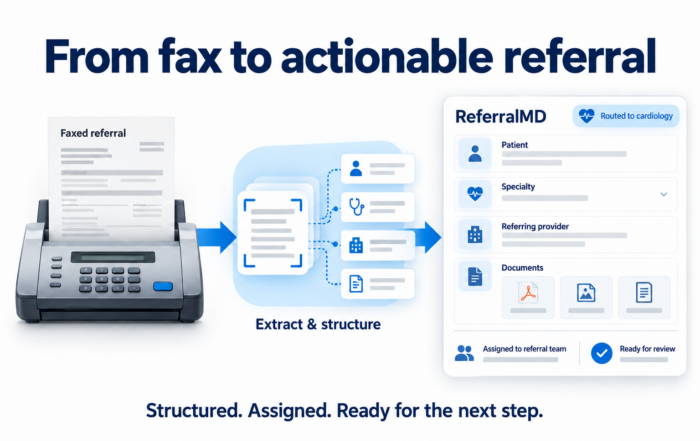
Referrals live across faxes, phone calls, portals, and email threads. When the data is scattered, accountability dissolves, and small breakdowns in intake, routing, scheduling, and follow-up add up into a pattern no one chose. You cannot manage what you cannot measure, and for years, referral networks were essentially unmeasured. The good news: centralized referral management turns that visibility problem into a solvable one.
What Data Analytics Actually Reveals About Referral Networks
The shift underway is less about flashy technology and more about finally connecting the dots. When referral data is captured in one place, ordinary questions suddenly have answers: Where are patients going? How long are they waiting? Which specialists actually have capacity?
Modern referral management platforms turn that scattered activity into something you can study. Using analytics to reduce referral leakage makes visible the kinds of metrics that were invisible a decade ago: leakage rates, capture rates, referral volume by geography, and even competitor referral patterns.
A few patterns tend to surface as soon as the data comes into focus.
Where Patients Actually Go
Leaders are often surprised by the gap between where they think referrals go and where they actually land. A specialty group may assume it captures most of a region’s volume, only to discover a steady stream heading to a competitor across town because of shorter wait times.
This isn’t about blame. It’s about understanding the real shape of patient flow so that capacity, staffing, and outreach decisions are grounded in evidence rather than assumption.
Where the Referral Network Breaks Down
Analytics also exposes the friction points. Service-level reporting can show how long a referral sits in each phase of the workflow, separating processing time from wait time from the time it takes to send results back.
Once those stages are visible, bottlenecks stop being mysterious. A practice can see that referrals pile up at scheduling, or that a particular intake step adds days of delay, and fix the specific thing that’s broken instead of guessing. Closed-loop referral tracking makes this kind of stage-by-stage accountability possible at scale.
Which Referring Relationships Are Working
Perhaps most interesting, data analytics reframes referral relationships as something you can nurture rather than assume. A referral coordinator can see which referring providers send consistent volume, which ones have gone quiet, and where a single conversation might reopen a productive channel.
That’s a meaningful shift for healthcare marketing and provider outreach, which historically ran on intuition and lunch meetings. The relationships still matter enormously. Now they’re informed by patterns instead of hunches. Platforms purpose-built for referrer relationship management track this activity automatically, combining referral data with outreach history so nothing falls through the cracks.
It also changes how we define an “important” referral relationship. Research published in JAMA on patient-sharing networks suggests that a provider’s centrality within the network — meaning how many shared-patient connections flow through them — often predicts their real clinical influence better than referral volume alone. In other words, the quietest connector in a network can matter more than the busiest one, and analytics is finally good enough to tell them apart.
What Claims Data Reveals About Local Markets
Internal referral data tells you about your own network, but it stops at your walls. Claims data — the billing records that follow patients across the entire system — fills in everything you can’t see on your own. Because a claim is generated almost every time care is delivered, the aggregate patterns expose how patients actually move between providers in a given market.
That’s especially powerful at the local level, where referral dynamics are often counterintuitive. Analysis of U.S. patient referral networks shows that shared-patient data exposes which primary care physicians and specialists are already sending patients back and forth, which referral relationships are strengthening or fading, and where patients are quietly traveling out of the area for care they could get nearby.
For a practice or health system, this turns market strategy from guesswork into something observable. You can see which neighboring providers are natural referral partners, spot a specialty gap that’s pushing patients elsewhere, and understand a competitor’s referral footprint — all without a single internal record. Used well, that view of local referral dynamics is one of the most practical ways healthcare IT is reshaping how networks grow.

Photo by Joshua Sortino on Unsplash
From Reactive to Predictive: The Next Stage of Referral Analytics
Early referral analytics was mostly a rear-view mirror. It told you what happened last quarter, which was useful but limited. The more consequential change is the move toward analytics that help teams act before a patient is lost.
When referral data flows in near real time, a coordinator can see a referral stall the moment it happens, not weeks later in a report. Advanced referral analytics and business intelligence approaches reflect this direction: monitoring referral status by journey stage so teams can intervene while it still matters.
A Simple Example
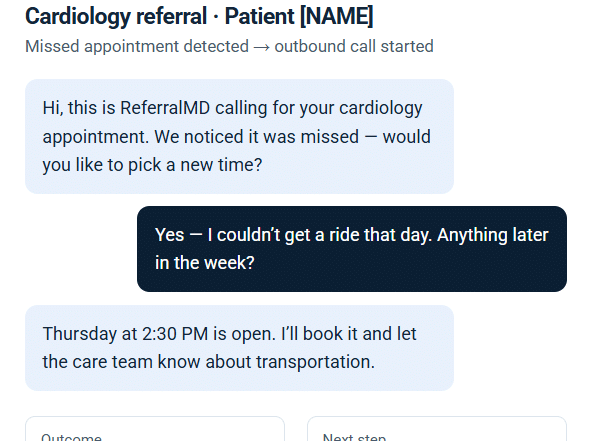
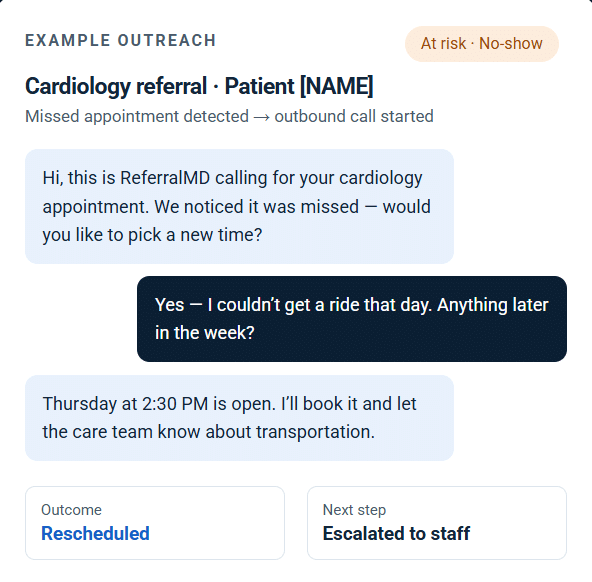
Picture a patient referred to a cardiologist who never schedules the appointment. In the old model, no one would notice until that patient resurfaced in an emergency department.
With connected referral data, the unscheduled referral shows up on a worklist within days. Someone calls, removes the obstacle, and the patient gets seen. The analytics didn’t deliver the care, but it made sure a human knew to step in. That is the quiet revolution: technology that surfaces the right moment for a person to act.
Real-world results bear this out. When The Neuron Clinic implemented a connected referral management platform, time from referral receipt to scheduled appointment dropped by 36%, and the number of referrals processed per coordinator increased by 87%.
What Referral Analytics Means for Patient Access and Experience
It’s easy to frame referral analytics as a revenue story, because the leakage figures are dramatic. But the more durable benefit is what it does for patient access and the patient experience.
Every stalled referral is a person stuck in limbo. When a health system can see and close those loops, patients spend less time chasing appointments, repeat fewer tests, and move through specialty care with less friction. Closed-loop referral management closes the loop so fewer patients fall through the cracks in the first place.
There’s a coordination benefit, too. When the referring provider actually learns what happened with their patient, care becomes more continuous and less fragmented. According to ReferralMD data, 63% of referring physicians are dissatisfied with the lack of timely progress updates after a referral — a gap that referral management platforms directly address. That feedback loop, long missing from healthcare, is one of the most underrated things good referral data makes possible.
The Risks Worth Naming
No honest look at this trend should ignore the tensions it creates. Data analytics is a tool, and tools can be pointed in unhelpful directions.
The first risk is treating referrals as purely a revenue-retention exercise. Keeping patients in-network is reasonable when the in-network option is genuinely best for the patient, and troubling when it isn’t. The clinical interest of the patient has to stay the deciding factor, and analytics should support that judgment rather than override it.
The second risk is drowning in dashboards. Metrics only help if they lead to action, and it’s entirely possible to build beautiful reports that change nothing. The goal isn’t more data. It’s the few signals that tell a real person to pick up the phone.
The third is forgetting that referral networks are, at bottom, human. The strongest networks still run on trust between clinicians. Analytics should deepen those relationships, not reduce them to a leaderboard.
How Practice Leaders Can Use Referral Analytics Effectively
For practices and health systems weighing this shift, the path forward doesn’t require a massive transformation overnight. A few practical steps tend to matter most.
Start by getting your referral data into one place — even imperfectly — so you can actually see the network you already have. From there, pick one or two metrics that connect to a real decision, such as how many referrals go unscheduled or how long patients wait at each stage. Resist the urge to track everything at once.
Then close the feedback loop with referring providers, because the relationship is the asset and the data simply protects it. Treat healthcare IT and analytics as a way to support the people doing the work, not as a replacement for clinical judgment or human follow-up. Done well, this is less about surveillance and more about finally seeing clearly.
Frequently Asked Questions About Physician Referral Network Analytics
What is referral leakage and why does it matter?
Referral leakage occurs when patients are referred to providers outside a health system’s preferred network, either because the referring physician lacked visibility into in-network options or because the referral process broke down before the patient was scheduled. It matters because it reduces both revenue and care continuity — and because the patients who “leak” often experience longer waits, repeated testing, and fragmented follow-up.
How does data analytics reduce referral leakage?
Analytics reduces leakage by making the referral network visible. When every referral is tracked from creation to appointment, coordinators can see in real time where referrals stall, which providers receive high volumes, and where patients are going out of network. That visibility enables targeted intervention — a phone call, a routing adjustment, a workflow fix — before the patient is lost.
What metrics should healthcare organizations track to manage referral networks?
Key referral network metrics include: referral capture rate (percentage of referrals that result in a completed in-network appointment), referral leakage rate, average time from referral to scheduled appointment, average time from referral to completed visit, referral volume by geography or referring provider, and unscheduled referral rate. These metrics connect directly to operational decisions and patient access outcomes.
What is closed-loop referral tracking?
Closed-loop referral tracking means every referral is followed from the moment it is created through scheduling, the appointment itself, and the return of outcome information to the referring provider. Nothing is considered complete until the loop closes — the receiving specialist has seen the patient and the referring physician knows what happened. This approach reduces care fragmentation and gives both providers and patients more confidence in the referral process.
How is claims data used to analyze physician referral networks?
Claims data — the billing records generated when care is delivered — allows health systems and researchers to map how patients actually move between providers across an entire market. By analyzing shared-patient patterns in claims data, organizations can identify natural referral partnerships, spot specialty gaps pushing patients out of the area, and benchmark their own network performance against local competitors without needing to access internal records from those competitors.
What is physician network centrality and why does it matter for referral strategy?
Network centrality measures how many shared-patient connections flow through a given physician, rather than simply counting how many referrals they send. Research on physician patient-sharing networks published in JAMA found that centrality is often a better predictor of clinical influence than raw referral volume. A physician with moderate volume but high centrality — meaning many pathways in the network run through them — can have an outsized effect on where patients ultimately receive care, making them a high-value relationship to prioritize in provider outreach.
A Quiet Shift With Loud Consequences
The reshaping of physician referral networks is happening without much noise. There’s no single dramatic moment, just a steady accumulation of visibility where there used to be guesswork.
The practices and systems that benefit most won’t necessarily be the ones with the fanciest technology. They’ll be the ones that use referral data to ask better questions, act sooner, and keep patients from falling through the cracks. In an industry where so much attention goes to the next big breakthrough, it’s worth noticing the quiet ones — because this is the kind of change that improves patient access and patient experience long after the headlines move on.
About Paul-Lukas Josten, CEO and Founder of Alpha Sophia
Paul-Lukas Josten is the founder and CEO of Alpha Sophia, a healthcare commercial intelligence platform that helps life sciences, MedTech, and healthcare teams understand the provider landscape. Alpha Sophia is a partner in the go-to-market motion of leading life sciences organizations, providing recent and trustworthy data as well as easy-to-use interfaces and reports. Connect with Paul on LinkedIn and follow Alpha Sophia on LinkedIn.
Related Posts


Subscribe to Our Blog
Recent Posts