For home health agencies, referrals are the lifeblood of the business — but a large share of those referrals never convert to admissions. Patients discharged from hospitals get placed with whichever agency responds fastest, has the right documentation ready, or simply has the best relationship with the case manager on duty. If your agency isn’t winning that moment, you’re experiencing referral leakage: revenue walking out the door to a competitor.
The problem is well-documented. According to the Centers for Medicare & Medicaid Services (CMS), there are more than 11,000 Medicare-certified home health agencies competing for referrals from roughly 6,000 hospitals and hundreds of thousands of referring physician practices. In that environment, even small operational gaps — a slow intake response, a missing insurance authorization, a fax that never arrived — can permanently redirect referrals to a competing provider.
This post covers the root causes of referral leakage specific to home health agencies and the practical strategies — operational, relational, and technological — that high-performing agencies use to capture and retain more of the referrals they’re owed.

What Is Referral Leakage — and Why Does It Hit Home Health So Hard?
Referral leakage occurs when a patient who was intended — or expected — to receive care from your agency ends up receiving it somewhere else. In home health, leakage happens at several distinct points in the referral journey:
- Pre-discharge: Hospital discharge planners have preferred vendor lists, and agencies not actively managing those relationships get bypassed entirely.
- At the point of referral: The referring party sends a referral; your agency is too slow to accept or respond, and it gets reassigned.
- During intake: Incomplete clinical documentation, insurance eligibility issues, or coverage gaps cause referrals to stall and ultimately cancel.
- Post-acceptance: A patient or family member expresses a preference for a different agency after discharge, and the hospital honors it.
Home health is particularly vulnerable because the window between discharge decision and actual discharge is often measured in hours, not days. Case managers under pressure will go with the agency that calls back first, has updated their service area on record, and can confirm insurance acceptance in real time.
The 6 Most Common Causes of Referral Leakage in Home Health
1. Slow or Missed Referral Responses
Hospital case managers typically work with 3–5 agencies simultaneously when placing a post-acute referral. The agency that acknowledges and accepts the referral fastest — often within 30–60 minutes — earns the patient. Agencies relying on manual fax monitoring, voicemail, or email chains routinely miss this window. See how ReferralMD’s home health solution automates referral alerts and acceptance workflows to eliminate response delays.
2. Fax-Based Referral Workflows
Despite widespread digitization elsewhere in healthcare, fax remains the dominant referral transmission method for hospitals and physician practices. Faxes get lost, misfiled, or buried in a shared queue — and there’s no automated audit trail proving receipt or response time. Agencies without intelligent fax-to-intake automation face structural disadvantages in competing for time-sensitive referrals.
3. Incomplete Clinical Documentation at Intake
CMS requires specific clinical documentation for home health admission, including physician orders, face-to-face encounter notes, and a signed Plan of Care. When referring hospitals submit incomplete referral packets, agencies that can’t quickly identify and close those gaps lose the referral to a more operationally nimble competitor. A structured home health intake process with documentation checklists dramatically reduces this source of leakage.
4. Limited Visibility Into Referral Source Performance
Many home health agencies can’t answer basic questions: Which hospitals refer the most patients? Which physician groups referred patients 6 months ago but have gone quiet? What’s our referral-to-admission conversion rate by source? Without this data, agencies can’t make targeted investments in the relationships and sources that drive the most census growth.
5. Lack of Proactive Relationship Management with Discharge Teams
Hospital discharge planning teams and physician office care coordinators change frequently. Agencies that don’t have a structured outreach program — consistent touchpoints, educational content, updated service capability communications — gradually fall off the preferred vendor list without knowing it.
6. Poor Insurance Eligibility Verification
Admitting a patient whose insurance won’t cover home health services, or failing to verify Medicaid spend-down requirements, creates downstream billing problems and can result in referral source dissatisfaction. Discharge planners remember when a referral turns into a coverage problem after the fact.
Strategies to Reduce Referral Leakage from Hospitals
Get on — and Stay on — Preferred Vendor Lists
Most hospitals maintain formal or informal preferred post-acute provider lists that guide case manager placements. Getting listed requires meeting credentialing and quality benchmarks; staying on the list requires active relationship management and performance accountability. Agencies should assign a dedicated liaison for each key hospital referral source, meet regularly with discharge planning leadership, and proactively share quality metrics like HHCAHPS scores, hospitalization rates, and timely start-of-care data.
The CMS Care Compare platform publishes home health agency quality ratings, and many hospital discharge teams use it for vendor evaluation. Ensuring your profile is accurate and your scores are competitive is a baseline requirement for referral capture.
Implement Real-Time Referral Acceptance and Tracking
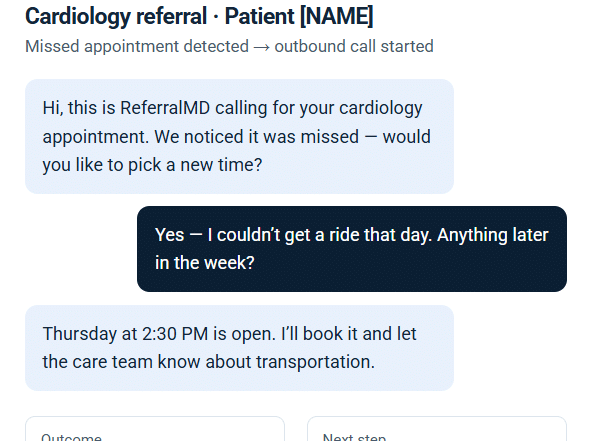
The operational gap between receiving a referral and confirming acceptance is where most leakage occurs. Referral management software eliminates manual intake bottlenecks by routing inbound referrals to the right intake coordinator automatically, tracking response time, and triggering alerts when referrals haven’t been acknowledged within a set threshold. Hospitals increasingly expect — and some are starting to require — electronic referral acceptance confirmation rather than a callback.
Automate Fax-to-Intake Conversion
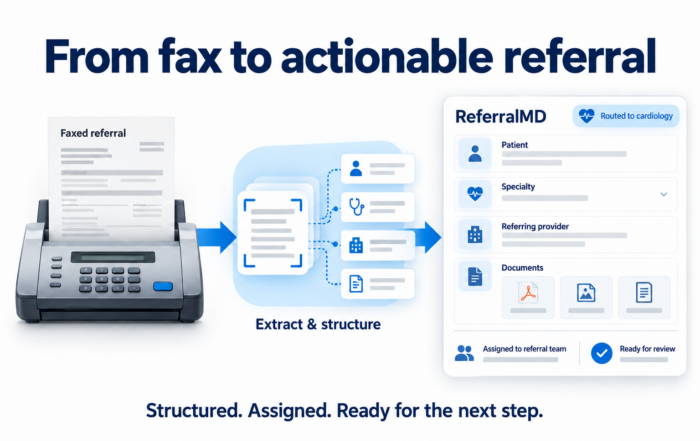
For agencies still receiving high volumes of faxed referrals (which is most of them), AI-powered fax automation can parse incoming clinical documents, extract structured patient data, and pre-populate intake workflows — eliminating the manual keying that slows response time and introduces transcription errors. ReferralMD SmartFax converts inbound fax referrals into structured digital records without staff intervention, enabling same-day response even during high-volume periods.
“Speed of response is the single biggest differentiator in winning hospital referrals. Clinical quality matters for retention — but you have to get the patient admitted first.”
— Common finding across home health operations benchmarking studies
Build a Hospital Liaison Program
High-performing home health agencies often employ dedicated hospital liaison staff whose sole job is to be physically present in hospital discharge planning departments, building relationships with case managers, social workers, and discharge planners. While this is a significant investment, even a part-time liaison covering 2–3 target hospitals can meaningfully shift referral volume. Liaisons should arrive with structured leave-behinds: service area maps, updated payer/insurance acceptance lists, quality scorecards, and contact information.
Strategies to Reduce Referral Leakage from Physician Groups
Map and Segment Your Referring Physician Network
Not all physician referral sources are equal. Primary care physicians, cardiologists, orthopedic surgeons, and wound care specialists each have different home health utilization patterns and patient populations. Agencies should segment their referral sources by specialty, volume tier (high/medium/lapsed), and geography — then develop targeted outreach for each segment. ReferralMD’s provider management tools allow agencies to track referral source relationships, log outreach activity, and identify sources at risk of churn before volume drops.
Reduce Friction in the Physician Referral Process
Physician practices refer patients to wherever it’s easiest. If your intake process requires a 20-minute phone call, a multi-page fax, and a follow-up callback — and a competitor requires a simple electronic order — you will lose that referral relationship over time. Streamlining the physician-facing referral pathway to a single-page electronic order form, with real-time status updates sent back to the practice, dramatically reduces friction and improves referral capture.
Close the Feedback Loop
Referring physicians often have no visibility into what happens to their patients after a home health referral is placed. Closing this loop — through automated status notifications, admission confirmations, and discharge-to-community outcome summaries — builds trust and demonstrates clinical accountability. According to research published in JAMA, care coordination communication gaps between physicians and post-acute providers contribute directly to preventable readmissions. Agencies that solve this communication gap become the preferred choice.

How to Measure and Monitor Referral Leakage
You can’t fix what you can’t measure. Home health agencies serious about reducing referral leakage should track the following KPIs on at least a monthly basis:
- Referral-to-admission conversion rate — the percentage of received referrals that result in admitted patients. Industry benchmark: 65–75%+ for high-performing agencies.
- Average referral response time — from referral receipt to first acknowledgment. Target: under 2 hours for hospital referrals.
- Referral volume by source — tracked monthly to identify growth and decline trends by hospital and physician group.
- Decline/lost referral reason codes — categorizing why referrals didn’t convert (geography, insurance, patient choice, timing) to identify fixable problems.
- Referral source retention rate — the percentage of active referral sources from the prior 12 months still referring in the current period.
- Time-to-admission — from referral receipt to first visit. Delays here can cause dissatisfied referral sources to route future patients elsewhere.
Referral analytics dashboards make these metrics visible in real time, allowing agency leadership to intervene before leakage becomes a census problem.
The Role of Technology in Closing Referral Leakage
Reducing referral leakage at scale requires more than process improvement — it requires technology infrastructure that connects your agency to referring hospitals and physicians in real time. The most effective platforms for home health agencies combine:
- Electronic referral intake — structured forms and direct EMR integration that eliminate fax-and-callback workflows
- Intelligent document processing — AI that reads incoming clinical faxes and routes relevant data to intake coordinators without manual re-entry
- Referral tracking and status dashboards — real-time views of every open referral, its status, and any documentation gaps
- CRM-style referral source management — tools for tracking outreach to referring physicians, logging relationship activities, and identifying at-risk sources
- Bi-directional communication with referring providers — automated status notifications that keep hospitals and physician practices informed at every step
ReferralMD was built specifically to address these needs across the post-acute continuum, including home health. Unlike general-purpose CRM tools or EMR add-ons, ReferralMD’s platform is purpose-built for referral management workflows — integrating with major EHR systems and enabling the kind of real-time, bi-directional referral communication that high-volume hospital referral sources increasingly expect.
Key Takeaways
Referral leakage is one of the most preventable sources of lost revenue in home health. The agencies consistently growing census in competitive markets share a few common characteristics:
- They respond to referrals faster than the competition — measured in minutes, not hours
- They have proactive, structured relationships with hospital discharge teams and physician offices
- They use technology to eliminate manual intake bottlenecks and documentation delays
- They track referral source performance with dashboards and act on the data
- They close the communication loop with referring providers — creating a feedback cycle that builds loyalty
The good news: most of the friction that causes referral leakage is fixable. The agencies winning in today’s market have made referral operations a strategic priority — not a back-office administrative function.
Ready to Stop Losing Referrals?
See how ReferralMD helps home health agencies capture more hospital and physician referrals, reduce intake friction, and grow census — without adding headcount.
Subscribe to Our Blog
Recent Posts