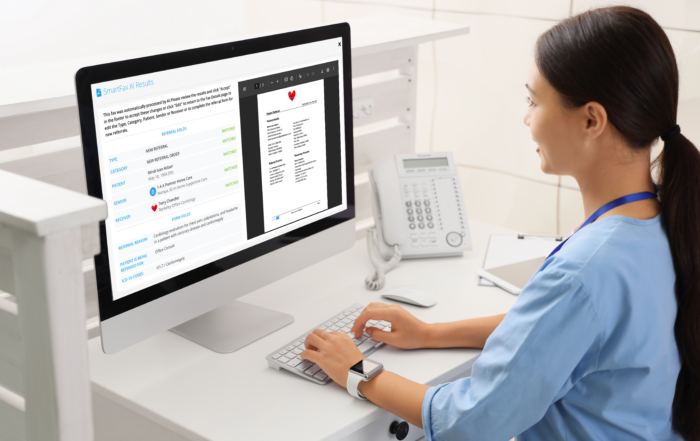
Referral management breakdowns rarely start with a workflow problem. They often start with data.
Most referral coordinators have seen it play out: a referral goes out, nothing comes back, and weeks later, someone realizes the specialist’s office moved six months ago. Or the NPI was wrong. Or the taxonomy code did not match what the payer expected.
These are not edge cases. Referral leakage, incomplete communication, and delayed follow-up are persistent challenges in healthcare, especially when provider records are inconsistent across systems. When your EHR, billing system, credentialing database, and referral management platform do not share clean provider data, everything downstream gets harder.
The CMS NPPES NPI Registry publishes public NPI record information, including provider name, specialty taxonomy, and practice address, and CMS also makes NPI data available through downloadable files and APIs. But keeping that data accurate inside your own referral workflow still requires active maintenance.
Below are seven provider data mistakes that commonly disrupt referral workflows, delay care, and contribute to claim denials.

Photo by Maksym Kaharlytskyi on Unsplash
1. Outdated Practice Location Information
This is one of the most common provider data issues because the record may look correct at a glance. The provider is real, the NPI is valid, but the address is from two years ago.
The patient shows up at the wrong location or calls a disconnected number. The appointment never gets scheduled. The referral sits open. Your no-show numbers climb. Your team spends time tracking down what happened instead of processing new referrals.
Provider directories need regular scrubbing against current data sources. If your organization is not auditing practice locations at least quarterly, there is a strong chance some referrals are being routed to outdated addresses.
Helpful link: Use the NPPES NPI Registry to verify public provider record details, including practice address and taxonomy.
2. Incorrect Taxonomy Codes
Payers use taxonomy codes to help identify a provider’s classification and specialization. When a code is incorrect, missing, or overly broad, it can lead to authorization delays, claim rejections, or manual review.
For example, a referral coded to general internal medicine when the provider actually practices cardiovascular disease may create unnecessary friction with payers. The provider may be qualified. The care may be appropriate. But if the documentation does not align with payer requirements, the referral or claim can still run into problems.
CMS notes that taxonomy codes are required for NPI enrollment and should reflect the provider’s classification or specialization.
Helpful link: CMS provides guidance on finding the correct taxonomy code.
3. Inactive or Invalid NPI Numbers
An inactive, mistyped, or mismatched NPI can prevent a referral from being scheduled before anyone picks up the phone. Systems may flag the submission. Payers may reject the authorization. Claims may bounce back because provider identifiers do not match.
The problem is that NPI validation often happens too late in the process. Nobody catches the issue until time and effort have already been spent.
This is one of the simplest problems to prevent. NPI verification tools can help staff confirm provider status, address, and taxonomy details before submitting a referral. A 30-second lookup is far better than a three-week denial rework cycle.
Helpful links:
- CMS overview of National Provider Identifiers
- NPPES NPI Registry
- NPPES API and downloadable file information
4. Confusion Between PTAN and NPI
PTAN and NPI are often mixed up in referral, authorization, and billing workflows.
The NPI is a universal 10-digit healthcare provider identifier used across payers. CMS describes the NPI as a HIPAA Administrative Simplification Standard and a unique identification number for covered healthcare providers. The PTAN, by contrast, is Medicare-specific and tied to a provider’s Medicare enrollment and billing relationship.
Put the wrong identifier in the wrong field, and your team may face delayed approvals, rejected authorizations, or unnecessary rework.
This is especially important for organizations with high Medicare referral volume. Training referral and authorization staff on when to use each identifier may sound basic, but it can materially reduce avoidable friction.

Hospital administrator in archives
5. Duplicate Provider Records Across Systems
If your organization runs an EHR, a referral management platform, a credentialing database, and a billing system, you likely have duplicate provider records.
The same specialist may appear as “Dr. Jane Smith, MD” in one system and “Smith, Jane M.” in another, with slightly different addresses, phone numbers, or affiliations.
That creates operational problems:
- Referrals get sent to the wrong record.
- Billing charges are split across entries.
- Referral volume reports undercount true activity.
- Staff spend hours reconciling records that should have been unified from the start.
Fragmented provider data gets worse when systems are disconnected. The more platforms you run without a shared provider master or centralized referral workflow, the more chances each record has to drift out of sync.
ReferralMD’s referral management platform helps organizations centralize referral workflows, manage referral activity, and improve visibility across provider networks.
6. Missing Credentialing or Network Participation Data
Everything about the referral can look right: the correct NPI, an accurate address, and a matching taxonomy. But if the specialist is not credentialed with the patient’s plan, or if network participation has lapsed, the authorization may still be denied.
Patient access teams often do not find out until the referral has already been submitted. Then come the phone calls, resubmissions, and patient frustration. In some cases, the patient may already have booked an appointment and will need to start over with a different provider.
Checking credentialing and network participation before sending the referral helps prevent these avoidable delays.
ReferralMD supports provider search and referral routing based on criteria such as specialty, accepted insurance, affiliation, average wait time, and distance from the patient, helping teams select the right provider earlier in the workflow.
Internal link: How do I find the right provider to send my referral to?
7. No Validation Step Before Submission
This is the mistake that ties all the others together. Many organizations submit referrals without a structured check of the basics.
Before a referral goes out, someone or something should confirm:
- The NPI is active and accurate.
- The taxonomy code matches the referral reason.
- The practice address is current.
- Credentialing and network participation are verified.
- The correct identifier is being used for the payer and workflow.
When this validation step is built into the standard referral workflow, denial risk goes down and referrals move faster. When it is missing, teams spend their time chasing preventable errors after the referral has already failed.
Automated provider verification at the point of referral makes this practical at scale without piling more manual work onto referral coordinators.
How to Reduce Referral Friction
Better referral performance starts with treating provider data as something that requires active maintenance, not something you set up once and forget.
Organizations that manage referral data well tend to follow a few best practices:
- Audit provider directories against current NPPES records on a regular schedule.
- Standardize names, addresses, credentials, and identifiers across systems.
- Assign ownership for provider data quality.
- Connect systems so that provider updates do not remain trapped in a single platform.
- Validate provider information before submitting a referral, not after a denial.
- Use analytics to monitor referral leakage, stalled referrals, and referral loop closure.
ReferralMD’s centralized referral management tools are designed to help healthcare organizations improve referral visibility, automate closed-loop feedback, manage referral communication, and reduce processing time.
Wrapping Up
Referral delays and claim denials are usually not caused by a single failure. They are caused by a stale address here, a wrong taxonomy code there, and an NPI nobody verified before submission.
Fixing this does not require a massive overhaul. It requires giving provider data the same level of attention your organization already gives patient data.
Run the audits. Standardize the records. Build validation into the workflow. Do not assume a provider record is correct just because it has been sitting in your system for years.
The organizations that get referral management right are not just moving referrals faster. They are working from cleaner, more reliable provider data.
Author Bio: Basrican Sen is the founder of NPIScan.com, a provider of a data verification platform that helps healthcare organizations reduce claim denials and referral errors through real-time NPI lookup and validation.
Related Posts



Subscribe to Our Blog
Recent Posts