The Digital Referral Loop: Solving the “Black Hole” in Behavioral Health Transitions
By Tariq Ghafoor, MD
Addiction Psychiatrist | Medical Director, Aurora Behavioral Health | Phoenix, Arizona | 25+ Years of Clinical Experience
Every week, across emergency departments, primary care offices, hospitals, and behavioral health facilities, clinicians send patients toward mental health or substance use disorder treatment — and then lose visibility into what happens next.
The referral gets written. The patient leaves. The discharge instructions are printed. A fax may be sent. A phone number may be handed over.
Then, somewhere between the discharge note and the intake appointment, the patient disappears into what many clinicians now call the behavioral health referral black hole.
This is not just an administrative inconvenience. It is a measurable care coordination failure that can lead to relapse, avoidable readmissions, crisis escalation, homelessness, suicide risk, and repeated emergency department utilization.
According to the 2024 National Survey on Drug Use and Health, many people who need treatment for a substance use disorder still do not receive it. Research also shows that a significant share of adults discharged from inpatient psychiatric care fail to attend follow-up care within 30 days — a gap associated with poor outcomes and preventable utilization.
As an addiction psychiatrist with more than 25 years in behavioral health, I have seen every variation of this failure. What concerns me most is not only the scale of the problem. It is how preventable it often is when health systems commit to closing the referral loop with the right technology, workflows, and care coordination protocols.
What Is the Behavioral Health Referral Black Hole?
The behavioral health referral black hole describes a recurring failure in the care journey: a patient is identified, assessed, and referred for specialized behavioral health care, but never actually receives that care.
The referring provider may not know whether the patient scheduled an appointment. The receiving facility may not receive complete clinical context. The patient, often in crisis and navigating stigma, transportation barriers, insurance requirements, or ambivalence about treatment, may disengage before care begins.
In practical terms, the referral exists, but the care transition fails.
A closed-loop referral process is designed to prevent that. It gives care teams visibility into whether a referral was received, scheduled, attended, and completed. Modern referral management software is built to close this visibility gap by tracking every referral from initiation through patient engagement.
Where Behavioral Health Referrals Break Down
The black hole is rarely caused by one single issue. It usually results from several gaps stacked together.
1. The handoff from the ER or primary care to behavioral health is too weak
A verbal referral, printed discharge instruction, or faxed document is not enough for many patients in crisis. Without a warm handoff, confirmed appointment, or follow-up protocol, the patient often leaves with a phone number instead of a care plan.
2. Referring providers lack closed-loop visibility
The referring provider may not know whether the patient contacted the behavioral health organization, scheduled intake, completed paperwork, or attended the first appointment. Without referral tracking, there is no early warning when a patient is about to fall through the cracks.
3. Intake workflows create administrative friction
Insurance verification, prior authorization, intake paperwork, missing documentation, and manual scheduling can delay care by days or weeks. For patients experiencing psychiatric instability, withdrawal, housing insecurity, or acute distress, delays can quickly become disengagement.
4. Patient barriers are predictable but often unmanaged
Transportation, stigma, co-occurring medical conditions, lack of family support, unstable housing, and fear of treatment are common. These barriers are addressable, but only if someone is tracking the patient through the transition and intervening before the appointment is missed.
Why Behavioral Health Referral Management Is a Healthcare IT Problem
Behavioral health has historically operated in a silo from general medical care. Many organizations still rely on disconnected EHRs, fax-based workflows, phone calls, spreadsheets, and manual follow-up.
For healthcare administrators and IT leaders, this is the behavioral health version of referral leakage. The consequences are not only financial. They are clinical, operational, and sometimes fatal.
Health systems need the same digital infrastructure for behavioral health transitions that they use for other high-risk care pathways: structured referral intake, secure communication, scheduling visibility, patient outreach, care team notifications, analytics, and documented outcomes.
A platform like ReferralMD helps centralize referral intake, scheduling, patient communication, AI fax workflows, and provider communication so teams can track referrals from request to appointment.

The Clinical Stakes: Why Behavioral Health Transitions Demand Better Coordination
Emergency Department Discharge Is a High-Risk Moment
Patients with mental health and substance use concerns are frequent users of emergency department services. Their visits are often complex, resource-intensive, and followed by poor outpatient follow-through.
From my vantage point at Aurora Behavioral Health in Phoenix, I see this repeatedly. A patient presents in acute withdrawal or psychiatric crisis. They are stabilized. They are discharged with a referral. Then they return within 30 days — sometimes within a week — having never connected with the recommended treatment program.
That is not necessarily a failure of the emergency department. It is a failure at the boundary between acute care and ongoing care.
That boundary is exactly where the digital referral loop matters most.
The 30-Day Window After Psychiatric Discharge Matters
For inpatient psychiatric discharge, the first 7 to 30 days are critical. The HEDIS Follow-Up After Hospitalization for Mental Illness measure tracks outpatient follow-up within 7 and 30 days after discharge, making it one of the most widely used behavioral health quality indicators.
Research has found that provider-to-provider communication before discharge improves the likelihood that patients attend follow-up care. In other words, care coordination is not just operationally cleaner. It changes patient behavior and improves the odds of engagement.
Substance Use Disorder Referrals Are Especially High Stakes
For patients with substance use disorders, the referral-to-treatment step is one of the most fragile points in the care continuum.
A patient may agree to treatment in the emergency department, during withdrawal, or during a moment of crisis. But motivation can shift quickly. If the intake appointment is delayed, the patient has to repeat their story, or transportation is not arranged, the opportunity can be lost.
The SAMHSA-HRSA SBIRT framework identifies referral to treatment as a critical component of care. How the referral is delivered has a major impact on whether the patient actually accesses treatment.
This is why behavioral health referrals require more than a name, diagnosis, and fax number. They require a trackable, coordinated process.
What Is a Digital Referral Loop?
A digital referral loop is a closed-loop care coordination process that tracks a patient from the moment a referral is created through confirmed engagement with care.
In behavioral health, a complete digital referral loop should answer five questions:
- Was the referral sent?
- Was it received by the right behavioral health provider or program?
- Did the patient schedule an intake appointment?
- Did the patient attend the appointment?
- If the patient did not attend, who followed up and what happened next?
Without those answers, health systems are not managing referrals. They are sending patients into uncertainty.
How a Closed-Loop Referral System Works in Behavioral Health
Step 1: Create a Structured Digital Referral With Complete Clinical Context
The referral should include the information the receiving facility needs to begin treatment planning, not just a patient name and diagnosis code.
That may include:
- Substance use history
- Co-occurring psychiatric diagnoses
- Medical comorbidities
- Current medications
- Insurance information
- Crisis context
- Discharge plan
- Social barriers
- Preferred communication method
- Urgency level
- Referring provider notes
Too often, the receiving behavioral health facility gets an incomplete fax days after discharge. By the time the complete clinical picture is assembled, the patient may already be lost.
Referral workflows should be embedded into the broader care process so the right information moves with the patient. ReferralMD’s provider referral management tools help referring and receiving organizations coordinate workflows, track status, and communicate directly around the referral.
Step 2: Give Referring Providers Real-Time Referral Visibility
Referring physicians, emergency department teams, hospitalists, and primary care providers need to know whether a patient connected with the receiving behavioral health facility.
A closed-loop platform should show:
- Referral received
- Referral accepted or declined
- Appointment scheduled
- Intake completed
- Patient no-show
- Patient unreachable
- Documentation missing
- Follow-up needed
When a patient fails to schedule or attend an intake appointment, the referring provider or care coordinator should be notified automatically.
This is the operational definition of closing the loop.
Step 3: Use Warm Handoffs Whenever Possible
A warm handoff is direct, real-time communication between the referring team and the receiving care team, ideally with the patient included.
In behavioral health, a warm handoff can make the difference between a patient leaving with instructions and a patient leaving with a real connection to care.
Where a live warm handoff is not possible, care navigators or peer support specialists can help bridge the transition by contacting the patient, confirming the appointment, addressing barriers, and reinforcing the care plan.
Step 4: Automate Patient Follow-Up and Re-Engagement
Manual follow-up is slow and inconsistent. Behavioral health transitions require fast, repeatable outreach.
Automated patient communication can help:
- Confirm the referral was received
- Send appointment reminders
- Deliver intake paperwork
- Provide directions or telehealth links
- Remind patients what to bring
- Flag no-shows for care coordinator follow-up
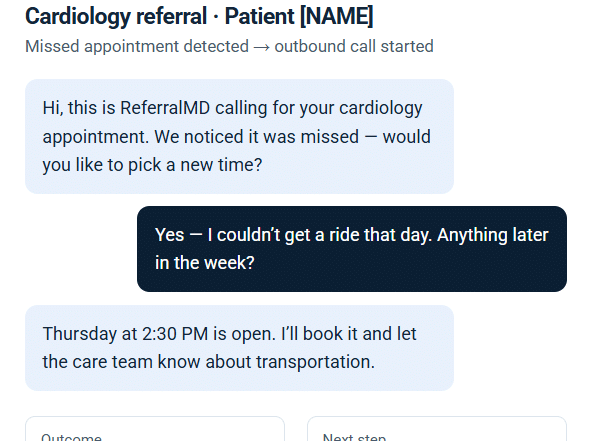
- Trigger re-engagement workflows
ReferralMD’s patient access and communication tools help teams connect scheduling, communication, and referral workflows so patients are not left to navigate the transition alone.
The goal is not to replace human care coordination. It is to make sure human intervention happens at the right moment.
Step 5: Measure Referral Conversion and Follow-Up Completion
Health systems cannot improve what they cannot measure.
Behavioral health referral dashboards should track:
- Referral volume by source
- Referral acceptance rate
- Time from referral to first contact
- Time from referral to scheduled intake
- Time from discharge to first appointment
- Referral-to-intake conversion rate
- No-show rate
- 7-day follow-up completion
- 30-day follow-up completion
- Leakage by provider, location, payer, or program
- Reasons referrals are delayed or declined
These metrics help administrators identify where patients are falling through the cracks and which interventions actually improve access.

Healthcare IT Requirements for Behavioral Health Referral Integration
For health system leaders, implementing a functional behavioral health referral loop requires more than a digital form. It requires infrastructure that supports care coordination across fragmented systems.
EHR Interoperability
Behavioral health EMRs must be able to exchange structured data with hospitals, emergency departments, primary care practices, and community partners.
Many specialized treatment facilities still operate on standalone systems with limited integration into hospital networks. That creates delays, duplicate data entry, missing documentation, and poor visibility.
Interoperability through HL7, FHIR, Direct messaging, APIs, and secure data exchange can help ensure referral information reaches the right team in a usable format.
AI Fax Management
Fax remains deeply embedded in healthcare referrals, including behavioral health. The problem is not only that fax is old. It is that traditional fax workflows are difficult to track, route, measure, and automate.
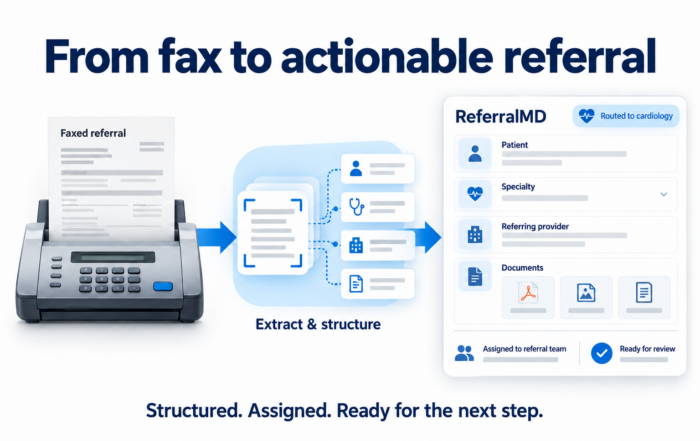
AI-enabled fax processing can help convert inbound faxes into structured referral workflows. ReferralMD’s SmartFax AI is designed to automate and streamline manual fax processing so teams can reduce delays and route referral information more efficiently.
For behavioral health, this matters because a missed or misrouted fax can become a missed opportunity for care.
Referral Tracking and Analytics
Behavioral health leaders need dashboards that show where referrals are coming from, how quickly patients are contacted, how many convert to intake, and why patients fail to engage.
From a value-based care perspective, referral completion is not just an operational metric. It is a quality and cost metric tied to readmissions, emergency department utilization, and continuity of care.
Patient Communication Integration
Automated SMS, email, and portal-based communication can help patients stay engaged during the critical window between referral and intake.
This is especially important for substance use disorder treatment, where readiness for care may be time-sensitive. A patient who is ready today may not still be ready a week from now if the system creates too much friction.
HIPAA and 42 CFR Part 2 Compliance
Behavioral health information carries heightened sensitivity, especially for substance use disorder treatment records governed by 42 CFR Part 2.
Any behavioral health referral platform must support secure, compliant communication and information exchange. General HIPAA compliance is not enough for organizations handling SUD treatment information. Health systems must evaluate consent workflows, permitted disclosures, audit trails, access controls, and how behavioral health records are shared across care teams.
Practical Steps for Primary Care, ER, and Hospital Teams
For the clinicians who initiate behavioral health referrals, there are practical steps that improve follow-through even before a full technology transformation is complete.
Schedule the Intake Appointment Before the Patient Leaves
The most important step is to ensure the patient leaves with a confirmed appointment, not just a referral.
That requires visibility into which facilities have availability, what level of care is appropriate, and what payer requirements must be addressed before intake.
Document Barriers to Follow-Through
Transportation, insurance gaps, unstable housing, family opposition, safety concerns, and stigma should be documented at the time of referral.
This helps care coordinators, peer support specialists, and receiving facilities intervene quickly instead of discovering barriers after the patient misses the appointment.
Communicate Provider-to-Provider
A discharge summary alone is not always enough. Direct communication between the referring provider and receiving clinician can transfer clinical context, clarify risk, and create accountability.
Even a brief secure message or phone call can improve continuity.
Track No-Shows Immediately
A missed first intake appointment should trigger same-day follow-up. Waiting several days often means the window for re-engagement has closed.
Closed-loop referral systems can automatically flag no-shows and notify the right team.
The Policy and Payer Dimension
Closing the behavioral health referral loop is not only a clinical and operational priority. It is also a payment and quality priority.
Value-based care models increasingly emphasize outcomes, readmission reduction, patient engagement, and continuity after discharge. Health plans, ACOs, CINs, and health systems have a financial incentive to invest in infrastructure that improves behavioral health follow-up.
The HEDIS Follow-Up After Hospitalization for Mental Illness measure tracks outpatient follow-up within 7 and 30 days after hospitalization for mental illness. Performance on measures like this can influence quality ratings, payer relationships, and value-based contract performance.
For behavioral health organizations, referral management is becoming part of the access infrastructure required to compete in a more accountable healthcare environment.
Why Behavioral Health Organizations Need Closed-Loop Referral Management Now
Behavioral health demand continues to rise while administrative teams remain stretched. Many organizations are trying to manage complex care transitions with phone calls, faxes, spreadsheets, and disconnected systems.
That model is no longer sustainable.
Closed-loop referral management helps behavioral health organizations:
- Reduce referral leakage
- Improve referral-to-intake conversion
- Shorten time to first appointment
- Improve communication with referring providers
- Reduce avoidable no-shows
- Support value-based care reporting
- Improve patient access
- Strengthen relationships with hospitals, primary care groups, ACOs, and payers
- Identify operational bottlenecks
- Support safer transitions after discharge
For organizations that receive referrals from hospitals, emergency departments, primary care groups, FQHCs, ACOs, or community partners, a digital referral loop can become a core operating system for access and care coordination.
FAQ: Behavioral Health Referral Management
What is behavioral health referral management?
Behavioral health referral management is the process of receiving, tracking, coordinating, and completing referrals for mental health and substance use disorder care. A strong referral management process ensures that patients do not simply receive a referral, but actually connect with the right level of care.
What is a closed-loop referral system?
A closed-loop referral system tracks a referral from the moment it is sent through receipt, scheduling, appointment completion, and follow-up. It gives both the referring and receiving providers visibility into the patient’s status.
Why do behavioral health referrals fail?
Behavioral health referrals often fail because of incomplete handoffs, manual fax workflows, scheduling delays, missing documentation, insurance barriers, transportation issues, stigma, and lack of follow-up after discharge.
How can technology improve behavioral health care transitions?
Technology can improve behavioral health transitions by digitizing referrals, automating patient outreach, routing documentation, tracking appointment status, notifying care teams about delays or no-shows, and reporting referral conversion metrics.
Why is the first follow-up appointment so important?
The first follow-up appointment after psychiatric discharge or substance use crisis is a critical point of engagement. Patients who successfully connect with outpatient care are more likely to remain in treatment and less likely to cycle back into crisis care.
What metrics should behavioral health organizations track?
Behavioral health organizations should track referral volume, time to first contact, time to intake, referral conversion rate, no-show rate, 7-day follow-up completion, 30-day follow-up completion, payer mix, referral source performance, and reasons referrals are delayed or declined.
Conclusion: Closing the Loop Is a Clinical and Operational Imperative
The behavioral health referral black hole is not inevitable.
It is the product of siloed systems, inadequate care transition infrastructure, manual workflows, and a historical failure to apply the same healthcare IT rigor to behavioral health referrals that we apply elsewhere in medicine.
The tools to close this gap already exist. Closed-loop referral platforms, HIPAA-compliant communication, AI-enabled fax management, patient outreach, care navigation, provider-to-provider communication, and referral analytics can all help keep patients connected through the most vulnerable moments in the care journey.
What is missing in many health systems is the organizational will to treat behavioral health care transitions as the clinical and operational priority they are.
Every patient who falls through the gap between referral and intake is a preventable failure. That patient could have entered treatment, stabilized, and begun recovery. Instead, too many cycle back through the emergency department, deteriorate in the community, or disappear from care entirely.
As both a clinician and a medical director, I believe the digital referral loop is one of the most important investments behavioral health organizations can make — not because it solves every problem in the system, but because it addresses one of the most critical failure points in the continuum of care.
References
- Substance Abuse and Mental Health Services Administration (SAMHSA). Release of the 2024 National Survey on Drug Use and Health. U.S. Department of Health and Human Services. https://www.samhsa.gov/blog/release-2024-nsduh-leveraging-latest-substance-use-mental-health-data-make-america-healthy-again
- SAMHSA-HRSA Center for Integrated Health Solutions. Referral to Treatment. Screening, Brief Intervention, and Referral to Treatment (SBIRT). https://www.integration.samhsa.gov/clinical-practice/sbirt/referral-to-treatment
- Smith, T. E., et al. The effectiveness of discharge planning for psychiatric inpatients with varying levels of pre-admission engagement in care. Psychiatric Services. PMC8695636. https://pmc.ncbi.nlm.nih.gov/articles/PMC8695636/
- Finnerty, M., et al. Continuity of Care and Discharge Planning for Hospital Psychiatric Admissions. Psychiatric Services. PMC7008713. https://pmc.ncbi.nlm.nih.gov/articles/PMC7008713/
- Agency for Healthcare Research and Quality (AHRQ). Comparing Two Ways to Help Patients Get Follow-up Care after a Mental Health Visit to the Emergency Room — The EPIC Study. NCBI Bookshelf. https://www.ncbi.nlm.nih.gov/books/NBK601636/
- Kohn, R., et al. The treatment gap in mental health care. Bulletin of the World Health Organization. PubMed PMID: 15640922. https://pubmed.ncbi.nlm.nih.gov/15640922/
- Bardach, N. S., et al. ED Visits and Readmissions After Follow-up for Mental Health Hospitalization. Pediatrics. PubMed PMID: 32404433. https://pubmed.ncbi.nlm.nih.gov/32404433/
- SAMHSA Center for Behavioral Health Statistics and Quality. Data Collections. https://www.samhsa.gov/data/data-we-collect
- NCQA. Follow-Up After Hospitalization for Mental Illness. https://www.ncqa.org/report-cards/health-plans/state-of-health-care-quality-report/follow-up-after-hospitalization-for-mental-illness-fuh/
- U.S. Department of Health and Human Services. Fact Sheet: 42 CFR Part 2 Final Rule. https://www.hhs.gov/hipaa/for-professionals/regulatory-initiatives/fact-sheet-42-cfr-part-2-final-rule/index.html
About the Author
Tariq Ghafoor, MD is a board-certified addiction psychiatrist and the Medical Director of Aurora Behavioral Health in Phoenix, Arizona. With more than 25 years of clinical experience in addiction medicine and behavioral health, Dr. Ghafoor specializes in evidence-based treatment for substance use disorders and co-occurring psychiatric conditions. He has worked extensively on care coordination, patient access, and the operational infrastructure required to keep patients engaged through every stage of the behavioral health continuum.
Related Posts



Subscribe to Our Blog
Recent Posts