Healthcare still runs on fax because it works everywhere, requires no shared software, and satisfies HIPAA — but the manual work surrounding it costs the industry billions. Roughly 70% of healthcare providers still exchange medical information by fax, about 9 billion fax pages move through U.S. healthcare every year, and nearly half of faxed referrals never become scheduled appointments. The fix isn’t eliminating fax. It’s automating everything that happens after a fax arrives — and that’s exactly what AI now makes possible.
In this post, we’ll look at the data behind healthcare’s fax dependence, what manual fax processing actually costs practices and health systems, why two decades of “kill the fax” initiatives have failed, and how AI-powered fax management turns healthcare’s oldest workflow into its newest efficiency gain.
How much of healthcare still uses fax?
The vast majority. In an MGMA Stat poll of nearly 1,600 healthcare leaders, 89% of healthcare organizations reported using fax machines. Federal health IT officials have estimated that at least 70% of healthcare providers still exchange medical information by fax — and by some industry estimates, that share rises to roughly 90% once you count faxes flowing into and out of EHR systems. All told, U.S. healthcare exchanges more than 9 billion fax pages annually.
That’s not a legacy habit clinging on at the margins. Fax remains the default channel for referrals, medical records, lab and imaging results, prior authorizations, and payer communication — the core transactions of care coordination.
Why does healthcare still use fax?
Because fax is universal, and healthcare’s digital alternatives aren’t. A fax works between any two organizations regardless of which EHR they run, requires no portal logins or shared credentials, transmits over ordinary phone lines, and is a HIPAA-acceptable channel for protected health information. Interoperability gaps do the rest: roughly 30% of healthcare organizations cannot engage in all four domains of interoperability (sending, receiving, finding, and integrating data) as defined by ASTP/ONC. When a specialist’s EHR can’t talk to a referring PCP’s EHR — or to the skilled nursing facility down the road that has no EHR at all — fax is the lowest common denominator that always works.
CMS called for the end of healthcare faxing by 2020. It didn’t happen, and it isn’t happening. The realistic question for practice leaders isn’t “How do we get rid of fax?” — it’s “How do we stop paying people to manually process it?”
What does manual fax processing actually cost?
Lost referrals, repeated tests, delayed care, and enormous administrative spend. The numbers tell a consistent story:
Referrals leak. Only about 54% of faxed referrals result in a scheduled appointment — meaning nearly half of the patients referred by fax never make it onto a specialist’s calendar. Across all channels, roughly 50% of professional referrals never result in a completed visit, and referral leakage drains an estimated $150 billion annually from U.S. health systems.
Clinical information goes missing. An estimated 30% of tests are reordered because results were lost to busy signals or missing faxes, and 25% of faxes don’t arrive before the patient’s first visit. Specialists feel it directly: 68% report receiving no preliminary information before a referral visit, and 70% rate the referral information they do receive as fair or poor.
Administrative waste compounds. The 2025 CAQH Index found that automation helped U.S. healthcare avoid an estimated $258 billion in administrative costs in 2024 — and that a $21 billion savings opportunity remains in the manual and partially manual transactions still being handled by phone, mail, and fax. CAQH has also estimated that fully automated administrative workflows save an average of 70 minutes per patient visit.
Every one of those statistics traces back to the same operational reality: somewhere, a staff member is standing at a fax queue, sorting pages, deciphering cover sheets, retyping patient demographics, and hoping nothing critical slipped through.
Why haven’t portals and direct messaging replaced fax?
Because they solve the sender’s problem, not the ecosystem’s. Provider portals require every external partner to adopt them. Direct messaging requires both sides to maintain addresses and workflows. HIEs vary by region and rarely cover the long tail of community providers, post-acute facilities, and small specialty practices. Each alternative works only when everyone on both ends of the transaction changes their behavior simultaneously — and in a fragmented system of hundreds of thousands of independent organizations, that never happens all at once.
Fax persists precisely because it demands nothing from the other side. That’s why the most practical modernization strategy inverts the problem: keep the universal channel, and eliminate the manual labor around it.
How does AI fax automation work?
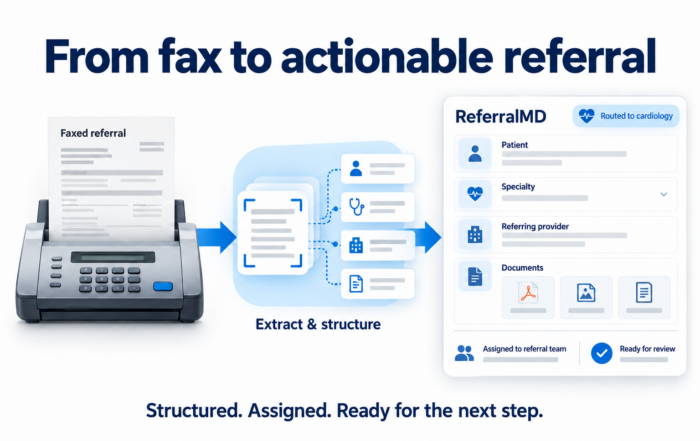
AI reads, classifies, and routes every fax the moment it arrives — turning an unstructured page into structured, actionable data. Here’s what that looks like in practice with SmartFax AI, ReferralMD’s intelligent fax management solution:
1. Capture and split. Inbound faxes are scanned, oriented, and split into individual documents automatically — no more sorting stacks of mixed pages.
2. Extract and match. AI-powered OCR pulls key identifiers — patient name, date of birth, gender, contact information — and advanced matching logic connects each document to an existing patient record or creates a new one, eliminating duplicate data entry.
3. Recognize and classify. Referring providers are identified automatically and contact profiles are built without staff lookup, while each document is categorized by type (referral, records, results) for correct handling.
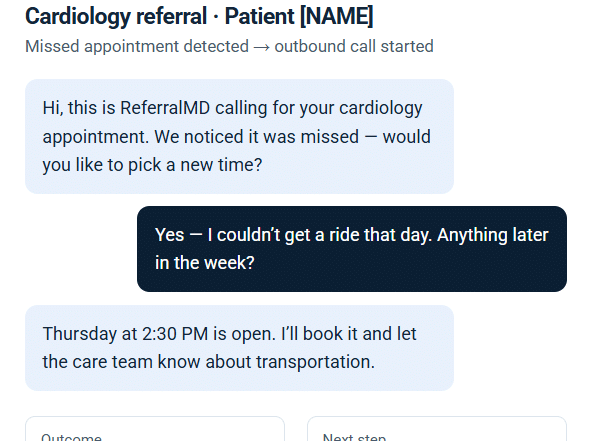
4. Route and create. Based on customizable rules, documents route to the referral work queue, staff review, or directly into the EHR and onto the correct patient chart. Faxed referrals become digital referrals instantly, entering the standard referral workflow with no manual entry — and automated weekly status updates close the loop with referring providers, which is one of the most reliable ways to grow referral volume from existing partners.
What used to consume hours of staff time per day happens in seconds — and nothing sits unprocessed in a queue where a time-sensitive referral can quietly expire.
What should you look for in a healthcare fax solution?
Look past “cloud fax” to true workflow automation. Moving from a physical machine to an online fax service digitizes the transport, but staff still process every page by hand. A healthcare-grade solution should offer:
AI data extraction and patient matching — not just an inbox of PDFs. Automatic referral creation, so faxed referrals enter a trackable workflow instead of a folder. EHR integration via API, HL7, FHIR, or Direct, so documents land on the right chart without rescanning. Flexible deployment — port existing numbers or provision new ones, centralized for a call center or decentralized by department. Closed-loop communication that automatically updates referring providers. And, non-negotiably, HIPAA compliance across the entire pipeline.
The bottom line: don’t kill the fax — kill the fax work
Fax isn’t healthcare’s problem; manual processing is. The organizations winning on access, referral conversion, and staff efficiency aren’t the ones that ripped out their fax lines — they’re the ones that stopped asking humans to do what AI does better. With nearly half of faxed referrals never converting to appointments and billions in administrative savings still on the table, automated fax intake is one of the highest-ROI changes a practice or health system can make this year.
See how SmartFax AI handles your fax volume — book a demo, or start free on the Practice tier and pay only for what you use. Full details on pricing.
Frequently Asked Questions
What percentage of healthcare communication is still done by fax?
Roughly 70% of healthcare providers still exchange medical information by fax according to federal health IT officials, and an MGMA poll found 89% of healthcare organizations use fax machines. U.S. healthcare exchanges more than 9 billion fax pages per year.
Why is fax still legal and HIPAA compliant in healthcare?
Fax is a point-to-point transmission over telephone infrastructure and is considered an acceptable channel for protected health information under HIPAA when reasonable safeguards are in place. Cloud fax platforms like ReferralMD add encryption, access controls, and audit trails on top of the fax channel.
How many faxed referrals result in appointments?
Industry data shows only about 54% of faxed referrals result in a scheduled appointment — meaning roughly 46% of faxed referrals are never scheduled. Automated intake, routing, and patient outreach are the primary levers for closing that gap.
What is AI fax automation in healthcare?
AI fax automation uses machine learning and OCR to read inbound faxes, extract patient and provider data, classify document types, match or create patient records, and route documents to the referral workflow or EHR automatically — replacing manual sorting, data entry, and routing.
Can AI fax software integrate with my EHR?
Yes. ReferralMD’s SmartFax AI connects through SmartEXCHANGE® with most EHR, PMS, and RIS systems via API, HL7, FHIR, or Direct — including Epic, MEDITECH, athenahealth, NextGen, Veradigm, eClinicalWorks, Greenway, Modernizing Medicine, and Nextech.
Sources
MGMA Stat poll via Fierce Healthcare ·
Bloomberg Law (federal health IT estimates) ·
Altera Digital Health ·
Konica Minolta Healthcare ·
2025 CAQH Index ·
Dialog Health referral statistics compilation
Related Posts

Subscribe to Our Blog
Recent Posts