How to Evaluate Referral Management Software: A Health System Buyer’s Guide
Key Takeaways
- Referral leakage costs the U.S. healthcare system roughly $150 billion a year, and about 38% of referrals stall before completion.
- A referral involves six sequential handoffs — matching, authorization, packet delivery, patient outreach, scheduling, and consult note return — and any one of them can break.
- Referral management platforms fall into four categories: EHR-native modules, patient engagement platforms, point solutions, and end-to-end platforms.
- The most important differentiator isn’t feature coverage — it’s whether a platform automates handoffs (including EHR write-back) or just tracks and displays their status.
- Evaluate integration depth, provider matching/routing, prior authorization handling, closed-loop tracking, and analytics before signing with any vendor.
- Measure your own baseline referral data before starting vendor evaluations.
Why Is Referral Management a Workflow Problem, Not Just a Tracking Problem?
Short answer: Referral management is a workflow problem because a referral requires six separate handoffs to succeed, and most leakage happens when those handoffs aren’t automated — not because organizations lack visibility into referral status.
The scale of the problem is well documented. Endeavor Management’s referral analytics practice puts referral revenue leakage from employed primary care physicians at 45%. HealthLeaders Media estimates the total U.S. cost of referral leakage at roughly $150 billion a year. MGMA’s 2025 data shows about 38% of referrals stall before the loop ever closes. Research indexed in PubMed Central puts completed subspecialist referral rates near 50%, and only about 54% of faxed referrals ever turn into a scheduled appointment.
A referral order in the EHR is the start of a process, not the end of one. Between the moment a PCP creates that order and the moment a patient sits down with a specialist, six handoffs have to succeed in sequence:
- Specialist matching — finding a provider who takes the plan, has availability, and fits clinically
- Prior authorization — submitting documentation and waiting on a payer decision
- Referral packet delivery — getting clinical records to the receiving office
- Patient outreach — reaching the patient and getting them to act
- Appointment scheduling — actually booking the visit
- Consult note return — closing the loop back to the referring provider
Software that improves visibility into these six handoffs without automating them still leaves staff to manually push referrals through each stage. That distinction — visibility versus automation — is the single most important filter in a software search, because it determines which category of platform is worth evaluating at all.
What Are the Four Types of Referral Management Platforms?
Short answer: Referral management platforms fall into four categories — EHR-native modules, patient engagement platforms with referral features, point solutions for single bottlenecks, and end-to-end referral management platforms — each with different strengths and coverage gaps.
| Platform type | Strength | Main gap |
|---|---|---|
| EHR-native referral modules (e.g., Epic, athenahealth) | No separate integration; data stays in the chart | Rarely automates outreach, payer authorization, or closed-loop reporting |
| Patient engagement platforms with referral features | Strong multi-channel patient communication | Weak provider-to-provider coordination (authorization, matching, packet routing) |
| Point solutions (fax intake, eligibility verification, prior auth tools) | Fast improvement at one specific bottleneck | Staff become the integration layer between disconnected tools |
| End-to-end referral management platforms (e.g., ReferralMD) | Manages intake through completed appointment as one workflow | Varies by vendor — check whether handoffs are actually automated, not just tracked |
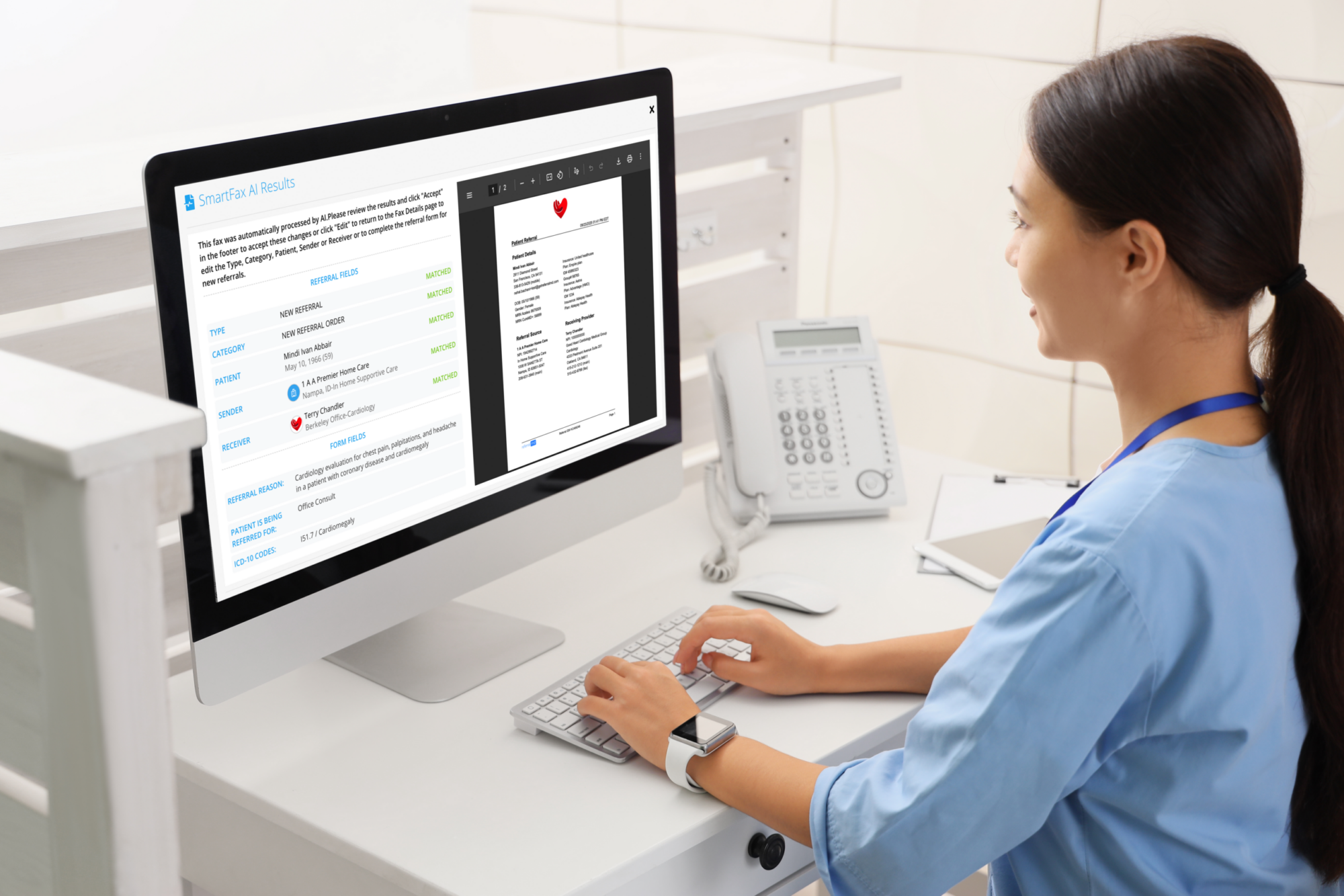
Within the end-to-end category, the real differentiator isn’t feature-list coverage — it’s whether a platform actively automates the handoffs between stages or gives staff a shared dashboard to manually push referrals through. A platform that agentically creates referrals, pushes structured data back into the EHR, and triggers next-step automations without staff intervention is solving a fundamentally different problem than one that only displays referral status and waits for a human to act.
How Should You Evaluate EHR Integration Depth?
Short answer: Evaluate EHR integration on four dimensions — automatic referral detection, data completeness, write-back capability, and the underlying data standard (HL7, FHIR, Direct, or API versus screen scraping) — because “we integrate with your EHR” can mean anything from a nightly CSV export to true real-time exchange.
- Referral detection — Does the system pick up new referral orders automatically, or does someone manually import them?
- Data completeness — Can the platform pull demographics, insurance details, clinical notes, and authorization status without manual copying?
- Write-back capability — Can the system push authorization decisions, appointment confirmations, and consult notes back into the EHR automatically?
- Standards — Is the integration built on HL7, FHIR, Direct secure messaging, or API connections, or does it rely on screen scraping that breaks with EHR updates?
ReferralMD’s SmartEXCHANGE interoperability layer supports standards-based exchange across HL7, FHIR, Direct Message, and API — a deliberate design choice, since referral workflows routinely cross organizational boundaries and touch multiple EHR systems. An integration that only works inside one EHR environment can’t manage the external referrals that drive most leakage.
Why Does Provider Matching and Routing Matter So Much?
Short answer: Provider matching matters because a referral to the wrong specialist — one with no availability, the wrong insurance participation, or poor clinical fit — is one of the fastest ways a patient leaks out of network or abandons the referral entirely.
A specialist needs to accept the patient’s insurance, have availability within a reasonable timeframe, sit within a practical distance, and be clinically appropriate. Many organizations still route referrals off spreadsheets that are outdated the day they’re created.
If the first specialist a patient is directed to can’t see them for six weeks, or doesn’t take their plan, the patient often books out-of-network with someone available sooner — or does nothing, and the referral evaporates. ReferralMD’s SmartMATCH engine routes patients based on cost, quality data, and clinical appropriateness together, rather than a static directory. Regardless of vendor, ask whether routing logic accounts for live insurance verification, current availability, and location — or whether staff still have to cross-reference a directory by hand.
How Should a Platform Handle Prior Authorization?
Short answer: A platform should auto-submit prior authorization requests with documentation attached, monitor payer portals for status without manual checking, alert staff immediately on denial, and keep authorization status on the same record used for the rest of the referral — because treating authorization as a separate workflow is where referrals stall most visibly.
The CMS Interoperability and Prior Authorization Final Rule is pushing payers toward electronic prior authorization and faster turnaround, creating an opening for platforms that connect directly to payer systems instead of routing staff through manual portal logins.
When evaluating a platform, check whether it can:
- Auto-submit authorization requests with required clinical documentation attached
- Monitor payer portals continuously for approval or denial status
- Alert staff immediately on denial so resubmission happens same-day
- Adapt to the specific documentation requirements of your highest-volume payers
What Does Closed-Loop Referral Tracking Require?
Short answer: Closed-loop tracking means following a referral through appointment attendance and consult note return to the referring provider — not stopping at “scheduled” — and includes no-show detection, note retrieval, and completion-rate reporting.
A referral isn’t complete when a patient schedules; it’s complete when the patient attends and the consult note reaches the referring provider. Closed-loop tracking should cover:
- Appointment confirmation and reminder sequences
- No-show detection with automatic re-engagement
- Consultation note retrieval from the specialist’s office
- Posting notes back into the referring provider’s chart
- Completion-rate reporting by source, specialist, payer, and patient population
Referring providers who consistently hear back about their patients send more referrals; those sent into a communication void eventually redirect referrals elsewhere. ReferralMD treats closed-loop tracking, including automated communication back to referring providers, as a core architectural principle rather than an add-on report.
What Analytics Should a Referral Management Platform Provide?
Short answer: A referral platform’s analytics should identify where referrals break — by specialist, payer, and patient population — not just report volume, because volume-only dashboards don’t lead to any specific fix.
At minimum, look for:
- Referral volume by source, specialty, and destination
- Time from referral receipt to first patient contact
- Conversion rates at each stage of the referral lifecycle
- No-show rates by specialist, payer, and outreach method
- Coordinator workload and task aging
- In-network versus out-of-network referral patterns
A second tier of analytics identifies which specialists have the longest delays, which payers are slowest on authorization, and which patient populations have the lowest completion rates. Kaufman Hall’s March 2026 National Hospital Flash Report puts median hospital operating margin at just 1.7% across more than 1,300 hospitals — at margins that thin, recaptured referral volume at existing reimbursement rates pays back within the same fiscal year, which is why quantifying leak points by revenue impact matters for building the investment case.
How Should You Structure a Software Evaluation Process?
Short answer: Measure your own referral data first, then push vendors past canned demos with your actual EHR and payer mix, talk to reference customers with similar size and complexity, and evaluate implementation timelines against a realistic two-to-six-week range.
- Baseline your own data first. Completion rates, average time from referral to scheduled appointment, coordinator hours per referral, and in-network versus out-of-network split — these become your benchmark for every vendor’s ROI claim.
- Push past the canned demo. Request a live walkthrough using your actual EHR and real, de-identified workflows. Ask which payer portals the platform connects to directly, and how it handles fax, portal, and Direct-message referrals together.
- Talk to comparable reference customers. A 20-provider specialty group on athenahealth has a different experience than a 500-bed system on Epic or an FQHC coordinating across community organizations.
- Evaluate timelines realistically. Purpose-built platforms typically need two to six weeks for deployment, including EHR integration and staff training. One-week promises likely oversimplify your complexity; eight-plus-week timelines may signal a resourcing problem.
See how ReferralMD automates referral handoffs end to end — from specialist matching through closed-loop reporting.
Frequently Asked Questions
What is referral leakage?
Referral leakage is when a patient referred to a specialist never completes that visit — the referral stalls, the patient goes out-of-network, or the loop never closes back to the referring provider. It’s estimated to cost the U.S. healthcare system roughly $150 billion annually.
What’s the difference between referral tracking and referral management?
Referral tracking shows the status of a referral at each stage. Referral management automates the handoffs themselves — matching, authorization, outreach, scheduling, and note return — rather than just displaying where a referral currently sits.
What should I look for in EHR integration for referral software?
Look for automatic referral detection, complete data pull (demographics, insurance, clinical notes, authorization status), bidirectional write-back to the EHR, and standards-based connections (HL7, FHIR, Direct, API) rather than screen scraping.
How long does referral management software take to implement?
Purpose-built platforms typically take two to six weeks, including EHR integration, workflow configuration, and staff training. Much shorter or much longer timelines are both worth questioning.
Why does prior authorization cause so many referrals to stall?
Because it’s often handled as a manual, separate process — staff submit requests through payer portals, wait days for a decision, and may not learn about a denial until the resubmission window has already slipped. Platforms that auto-submit, monitor status, and alert on denial in real time reduce that delay.
What is closed-loop referral tracking?
Closed-loop tracking follows a referral through the entire lifecycle — including appointment attendance and consult note return to the referring provider — rather than stopping once an appointment is scheduled.
Making the Decision
Choosing referral management software affects patient access, provider relationships, operational cost, and revenue capture at once. Organizations that get this right define the problem in workflow terms, measure their own operational gap, and evaluate every platform on one question: does this automate handoffs, or does it just document them?
Related Posts


Subscribe to Our Blog
Recent Posts