How Referral Management Platforms Reduce Patient Leakage in Healthcare Networks
Referral management platforms like ReferralMD reduce patient leakage by giving
health systems, ACOs, CINs, and multispecialty groups full visibility into every referral,
automating follow-up, routing patients to the right in-network provider, simplifying scheduling,
and flagging referrals at risk of falling through the cracks.
Instead of relying on disconnected fax queues, spreadsheets, phone calls, and individual staff
memory, a referral management platform creates one coordinated workflow that runs from referral
receipt through scheduled and completed care. For networks trying to keep patients in-network,
that coordination is often the difference between a completed referral and a lost patient.
processes create it, seven ways a platform like ReferralMD closes those gaps, and what to look
for when evaluating referral management software.
What Is Patient Leakage in Healthcare?
Patient leakage occurs when a patient is referred for care but does not complete that care within
the intended healthcare organization or provider network.
Leakage typically happens when a patient:
- Is referred to an out-of-network provider
- Never receives a scheduling call
- Cannot reach the receiving practice
- Does not know what to do next
- Encounters delays caused by missing information
- Abandons a complicated intake or authorization process
- Misses an appointment and is never re-engaged
- Chooses another provider offering faster access
Some leakage reflects patient preference, insurance requirements, geography, or clinical need.
But a significant share starts as an operational breakdown: the referral was never received, the
patient was never contacted, staff couldn’t identify the right provider, or no one could see that
the referral had stalled. That operational share is exactly what a referral management platform
is built to close.
Why Traditional Referral Processes Create Leakage
Many healthcare organizations still manage referrals through a patchwork of fax machines,
telephone calls, EHR work queues, spreadsheets, portals, and manual data entry. Every additional
handoff is another opportunity for delay or lost information.
A referral may be clinically appropriate the moment it leaves the referring provider — that
doesn’t guarantee the patient ever receives care. Someone still has to:
- Receive and review the referral
- Confirm the required information is present
- Determine the correct provider, location, and service
- Verify eligibility or authorization requirements
- Contact the patient
- Schedule the appointment
- Complete intake
- Confirm the visit occurred
- Communicate the outcome back to the referring provider
When these steps happen across disconnected systems, network leaders often have no way to know
which referrals are still incomplete, or why patients are leaving the network in the first place.
Seven Ways Referral Management Platforms Reduce Patient Leakage
1. They Create Visibility Across the Referral Journey
Healthcare organizations can’t reduce leakage they can’t see. ReferralMD centralizes referral
activity and tracks each patient through defined stages — received, under review, missing
information, patient contacted, ready to schedule, appointment scheduled, patient seen, referral
completed, or referral declined/redirected.
This visibility lets referral coordinators and patient access teams quickly spot referrals that
have stopped moving. At the network level, leaders can see where leakage is concentrated, which
service lines have the longest delays, and which referral sources have the lowest completion
rates.
2. They Replace “Send and Forget” With Closed-Loop Tracking
In an open-loop process, the referring provider sends a referral and may never learn whether it
was received, scheduled, or completed. Closed-loop referral management builds
accountability into the entire process — referral status is tracked until the patient
receives care or the referral reaches another documented resolution.
This surfaces:
- Unaccepted referrals
- Unscheduled patients
- Missed follow-up deadlines
- Incomplete appointments
- Referrals that need reassignment
- Patients who need additional outreach
No referral simply disappears into a fax queue or an inbox without a visible status.
3. They Route Patients to the Right In-Network Provider
Patients are more likely to leave a network when coordinators can’t quickly identify an
appropriate provider with the right specialty, location, insurance participation, and
availability. ReferralMD’s SmartMatch intelligent routing engine uses
provider directories, network rules, and matching logic to route each patient to an appropriate
in-network resource automatically.
Routing decisions can factor in:
- Specialty and subspecialty
- Patient location
- Insurance participation
- Provider availability
- Appointment type
- Clinical criteria
- Preferred facilities
- Network affiliation and referral rules
Better provider matching cuts down on incorrect referrals, repeated handoffs, and the delays that
push patients to seek care elsewhere.
4. They Shorten the Time Between Referral and Appointment
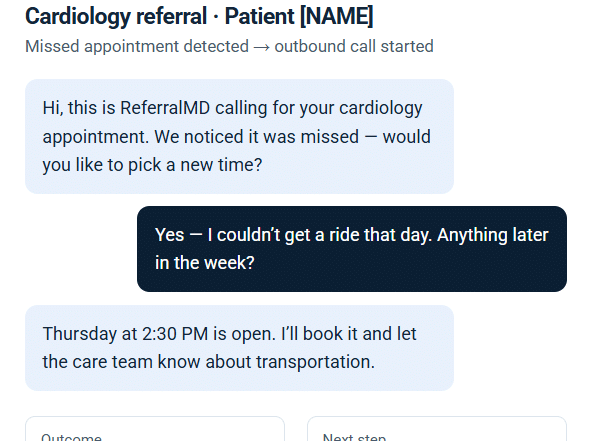
Speed matters. When patients wait days for a callback — or can’t reach the receiving office
— they often call someone else. ReferralMD combines referral workflows with patient
scheduling to move patients from referral receipt to a confirmed appointment faster, by:
- Retrieving current provider availability
- Applying scheduling rules
- Offering appropriate appointment times
- Letting patients schedule digitally
- Supporting staff-assisted or Voice AI scheduling
- Writing confirmed appointments directly into the connected EHR, PMS, or scheduling system
Completing the scheduling transaction is far more effective than sending a booking link or another phone number and hoping the patient follows through.
5. They Automate Patient Outreach and Follow-Up
Patients often disengage because they’re unsure what to do next — not because they’ve
decided against care. Automated communications keep them moving with:
- Referral confirmations
- Scheduling instructions
- Appointment reminders
- Digital intake forms
- Missing-information requests
- Preparation instructions
- Rescheduling options
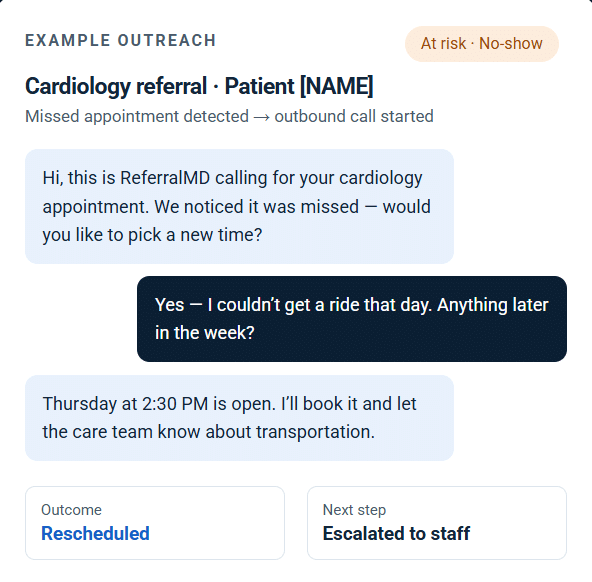
- Follow-up messages after a missed appointment
ReferralMD delivers this outreach across the channels a network already uses — text, email,
phone, portal notifications, or automated voice — reducing how much of this falls on staff
making repeat calls.
6. They Identify and Recover At-Risk Referrals
Not every delayed referral is permanently lost. ReferralMD flags referrals based on elapsed time, workflow status, missed appointments, failed contact attempts, or other organization-defined conditions, so teams can prioritize the patients most likely to need intervention — for example:
- Urgent referrals that remain unscheduled
- Patients who haven’t responded to outreach
- Referrals waiting on clinical review
- Referrals missing documentation
- Canceled appointments that were never rescheduled
- Referrals approaching a service-level deadline
Automation handles detection and prioritization, so staff spend their time on the exceptions that actually need human judgment.
7. They Turn Leakage Into Measurable Network Performance
Without centralized reporting, organizations may know leakage exists but lack the data to fix it. ReferralMD’s analytics surface:
- Referral volume by source and destination
- In-network versus out-of-network routing
- Referral acceptance rates
- Time from receipt to first contact
- Time from referral to appointment
- Scheduled and completed referral rates
- Cancellation and no-show trends
- Leakage by specialty, provider, location, or payer
- Common reasons referrals don’t reach completion
These insights help leaders find bottlenecks, adjust capacity, strengthen referral relationships, and measure whether workflow changes are actually improving completion rates.
Example: How ReferralMD Prevents Leakage
Consider a patient referred by a primary care provider to a cardiologist.
In a fragmented process, the referral is faxed to a practice, dropped into a work queue, and
reviewed days later. Staff discover missing insurance information, leave a voicemail, and wait for
a callback. Concerned about the delay, the patient schedules with another health system instead.
With ReferralMD connected across the network:
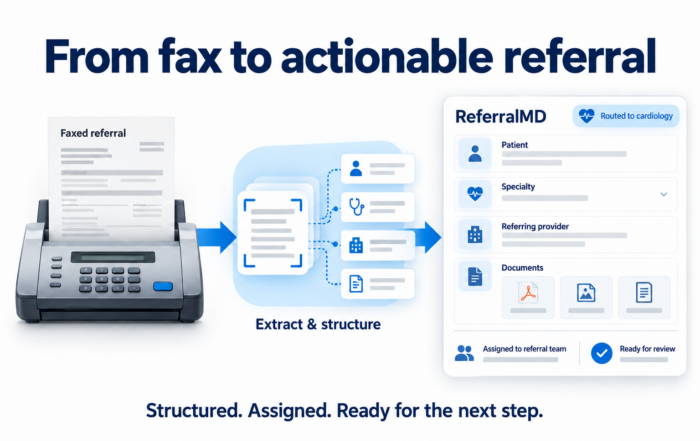
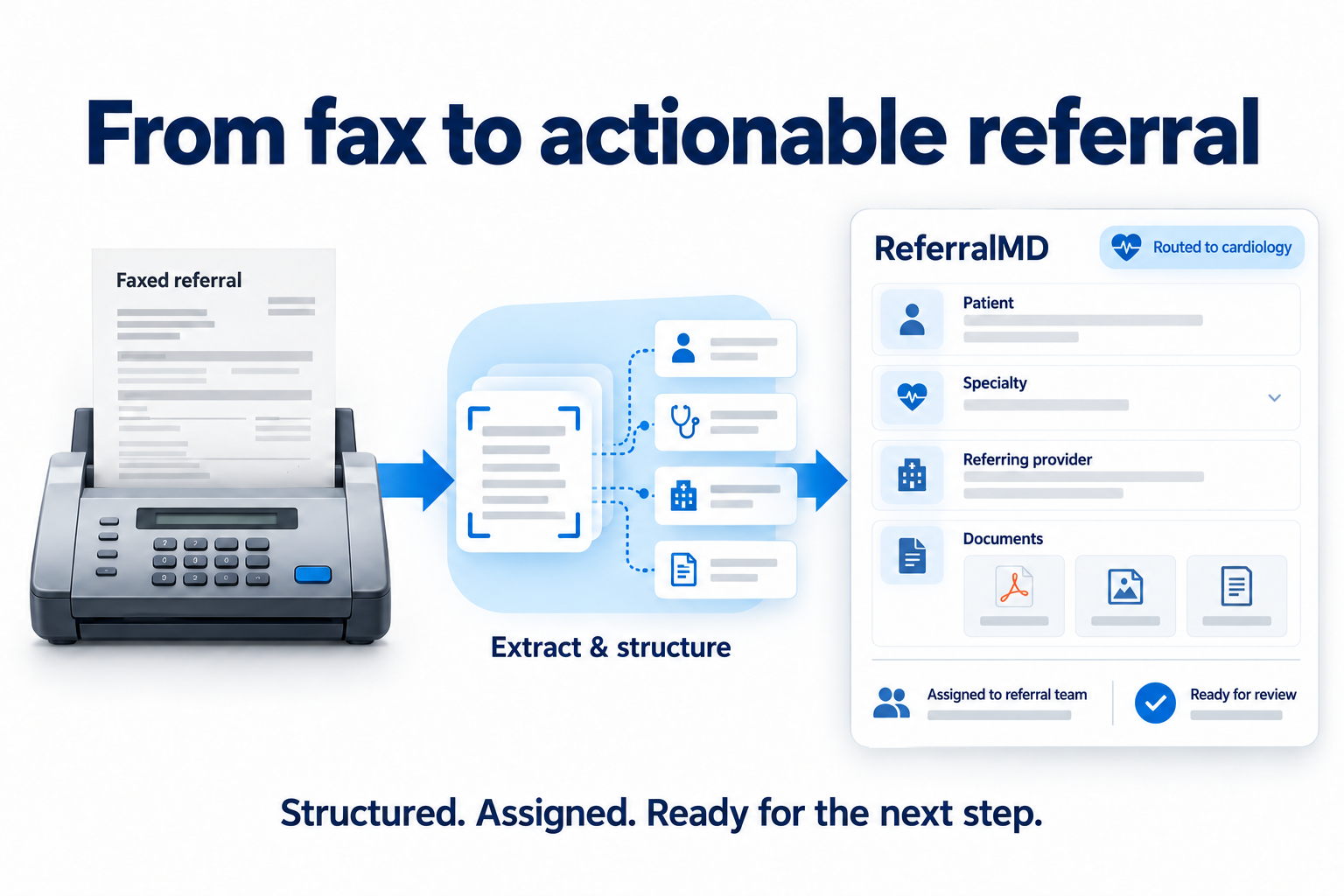
- The incoming fax or electronic referral is captured and assigned automatically by SmartFax AI
- Patient and referral information is organized for review
- Missing information is flagged early
- SmartMatch routes the patient to an appropriate in-network cardiologist
- Current appointment availability is retrieved
- The patient receives outreach and schedules an appointment
- Reminders and intake instructions go out automatically
- The referring provider can see the referral’s status in real time
- The network records whether the visit was completed
The platform doesn’t just transmit the referral — it coordinates every step required to turn that referral into completed care.
What to Look for in a Referral Management Platform
To reduce patient leakage effectively, look for a platform that addresses the entire referral journey, not just one piece of it:
| Capability | Why it matters |
|---|---|
| Inbound and outbound referral management | Handles referrals in both directions across the network |
| Closed-loop status tracking | Nothing disappears without a visible resolution |
| AI-powered fax and document processing | Eliminates manual data entry from incoming faxes |
| Provider directory management | Keeps routing data accurate and current |
| Intelligent provider matching and routing | Gets patients to the right provider on the first try |
| Real-time scheduling | Converts referrals into confirmed appointments faster |
| Direct EHR or scheduling write-back | Keeps referring and receiving providers in sync |
| Automated patient communications | Keeps patients engaged between steps |
| Digital patient intake | Reduces friction before the visit |
| Eligibility and authorization workflows | Catches barriers before they cause delays |
| Configurable alerts and escalation rules | Surfaces at-risk referrals automatically |
| Network-wide analytics | Turns leakage into a measurable, fixable metric |
| Bidirectional EHR integration | Works with the systems already in place |
| Support for independent and unaffiliated providers | Reaches providers regardless of their tech stack |
The platform should also work across the communication methods a network already uses. Requiring
every external provider to adopt the same EHR, or log into a separate portal, tends to create new
barriers instead of removing them — which is why ReferralMD’s
SmartEXCHANGE connects any provider through their preferred method,
without forcing a new login or a shared system.
How ReferralMD Helps Healthcare Networks Reduce Leakage
ReferralMD’s patient leakage reduction platform combines referral management,
patient engagement, scheduling, provider matching, AI-powered fax processing, intake,
integrations, and analytics in a single referral operating platform. Networks use ReferralMD to:
- Capture referrals from multiple inbound channels
- Track referrals from receipt through completed care
- Route patients using network-specific rules via SmartMatch
- Automate patient and provider communications
- Identify stalled or incomplete referrals
- Schedule patients using current availability
- Write appointments into integrated systems
- Measure referral completion and network performance
- Connect unaffiliated providers across different technology environments with SmartEXCHANGE
The result is a more visible, accountable, and coordinated referral process — one designed to help more patients receive the care they need within the appropriate network.
your network is leaking referrals today and how closed-loop tracking, SmartMatch, and automated
outreach close those gaps.
Frequently Asked Questions
How do referral management platforms reduce patient leakage?
Referral management platforms reduce patient leakage by tracking every referral, routing
patients to appropriate in-network providers, automating outreach, accelerating scheduling, and
alerting staff when referrals stall. They also provide analytics that show where and why
patients leave the network.
What is the difference between referral leakage and referral abandonment?
Referral leakage generally means the patient receives care outside the intended network.
Referral abandonment means the patient never completes the recommended care at all. The same
operational problems — delayed contact, scheduling barriers, missing information, and poor
communication — can contribute to both.
Can referral management software prevent all patient leakage?
No platform can prevent leakage caused by every clinical, insurance, geographic, or
patient-choice factor. Referral management software can, however, reduce preventable leakage
caused by lost referrals, delayed follow-up, incorrect routing, scheduling friction, incomplete
information, and limited workflow visibility.
How does closed-loop referral management prevent leakage?
Closed-loop referral management tracks a referral until the patient receives care or the
referral reaches another confirmed resolution. It keeps referrals from being sent without
acknowledgment and makes incomplete or stalled referrals visible to staff.
How does scheduling affect patient leakage?
Long response times and complicated scheduling processes give patients more chances to
disengage or choose another provider. Integrating scheduling into the referral workflow, as
ReferralMD does, reduces delays and helps convert a clinical recommendation into a confirmed
appointment.
Can ReferralMD work across different EHR systems?
Yes. ReferralMD uses APIs, HL7, FHIR, Direct secure messaging, SmartFax AI, and other
integration methods to coordinate referral information across different EHRs, practices, and
care settings — including independent and unaffiliated providers through SmartEXCHANGE.
Patient leakage isn’t only a network utilization problem — it’s often a sign that patients
are hitting unnecessary barriers between referral and care. By combining visibility, automation,
provider matching, scheduling, communication, and analytics, ReferralMD helps healthcare
organizations find those barriers and remove them before patients are lost.
Related Posts

Subscribe to Our Blog
Recent Posts