Healthcare marketing has become pivotal for healthcare organizations (such as clinically integrated networks, accountable care organizations, community health centers, health systems), individual practices (primary or specialty care), and related businesses.
Implementing targeted marketing strategies enables these groups to promote newly developed medical equipment or devices, increase health awareness within communities, and inform physicians and patients about technological innovations and wellness programs.
A recent report reflects that the global healthcare advertising market is projected to reach USD 68.64 billion by 2032 with a growing CAGR of 5.50%. Also, the USA will be dominating this market with an estimated valuation of USD 34.3 billion by 2033, with the largest revenue share worldwide.
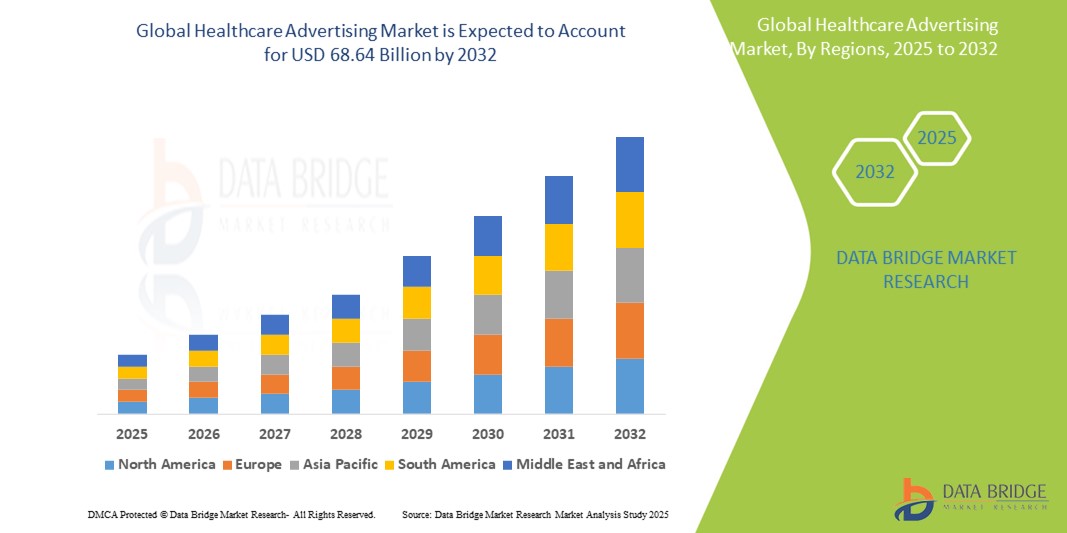
(Source: Healthcare Advertising Market Size )
So, which marketing trends will be the key driving force in the fast-paced healthcare industry? The increasing adoption of digital health platforms, cutting-edge Artificial Intelligence and Augmented Reality, and other factors will propel this market growth. To know more, dive deep into this blog as we’ve explored healthcare marketing trends from a variety of fresh and insightful perspectives.
What’s Driving the Shift in Healthcare Marketing?
The following reasons have profoundly reshaped the industry and fundamentally changed patient expectations, making strategic marketing essential for the survival and growth of organizations and individuals.

No #1: Rapid Digital Transformation & Ever-Evolving Patient Expectations: The healthcare industry is increasingly using telemedicine platforms, online search tools, virtual patient care and more.
For instance, Augmented Reality (AR) devices offer a 360-degree virtual perspective of any product before actually receiving it in hand. Hence, the use of AR is estimated to reach at approximately USD 15.2 billion by 2033. Similarly, the telehealth market will hit the global healthcare market to a projected valuation of USD 455.27 billion by 2030.
No #2: Smarter Marketing with Data Analytics and IT Solutions: The rise of healthcare IT, data analytics tools, patient behavior, and outcomes measurement, and personalized outreach are factors that influence healthcare marketing.
For example, the combination of Artificial Intelligence (AI) and Machine Learning (ML) tools analyzes extensive healthcare datasets that elude human efforts. These tools evaluate the complex data patterns and trends, highlight the high-risk patients, and automate a personalized approach.
No #3: Regulatory, Privacy & Trust Considerations: As more patient data is transferred through digital channels, balancing marketing efforts with compliance, patient privacy, transparency, and trust has become necessary for healthcare organizations. Transparent data privacy policies, security protocols, consent forms, and other key considerations should be clearly mentioned on websites, emails, and social media platforms.
Top 9 Healthcare Marketing Trends Shaping this Industry
Let’s dive into this section below to get a sneak peek at the major trends that will rapidly transform the healthcare industry.
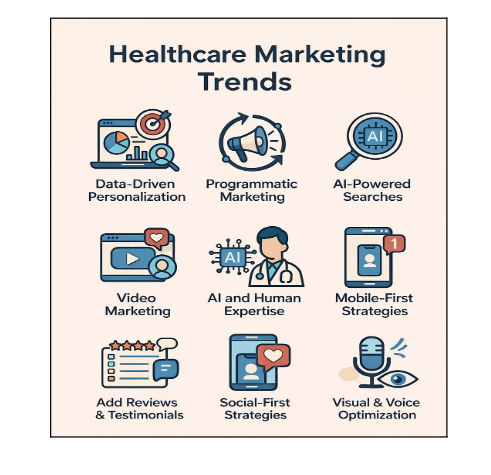
No #1: Data-Driven Personalization
Gone are the days of implementing a generic approach for all audiences.
Why? Because to get long-term business success, the marketing messages should be personalized, strategic, and resonate with your target audience.
Data-driven personalization in healthcare marketing ensures that healthcare providers exactly understand the requirements of their patients. After analyzing patients’ satisfaction scores, online reviews, feedback, and engagement metrics, they can share the most relevant and helpful content that solves their current challenges.
For instance, leveraging analytics, healthcare providers can send timely reminders to patients with chronic conditions to refill prescriptions, enroll in wellness programs, and schedule preventive screenings. These initiatives gradually reduce patient readmission rates, increase compliance rates, and save costs.
No #2: Programmatic Display in Healthcare Marketing
In the dynamic healthcare sector, programmatic display is an invaluable go-to-market resource as it enables marketers to directly connect with the right prospects with highly relevant messages.
With this automation technology, the visually appealing Ads are strategically displayed in front of the most potential physicians and patients, which gradually increases the conversion rates. A recent study highlights that the global programmatic advertising market will hit a market valuation of USD 30.1 billion by 2032.
No #3: Increased AI-Powered Searching Tools
For more than 15 years, internet users had relied on a static search process to get information. For example, they used to type a string of competitive keywords like best neurologists and cardiologists, then clicked on the top relevant websites and read all the information until they got accurate answers. But now, AI-powered search tools have streamlined this process through the following ways:
- Perplexity.ai, Google’s AI overviews, Co-Pilot by Microsoft, and other AI-friendly tools are significantly transforming how patients search for information online.
- AI-powered searching tools use cutting-edge machine learning and natural language processing (NLP) to evaluate the context and search intent, and provide more accurate results to users.
- With the increased adoption of AI-powered search tools, healthcare seekers can now easily access the most accurate information. Such information includes steps to schedule self-appointments, choose the best treatment options, and identify the most beneficial insurance plans for them.
- Apart from healthcare seekers, organizations can also benefit through AI-powered searches that enable them to access the most accurate information for proper diagnosis, streamline their administrative tasks, and improve patient engagement.
No #4: Video Marketing Dominance
Engaging video content is an excellent medium to explain complex health topics that patients find difficult to digest. Here’s how healthcare brands implement a video marketing strategy:
- Bite-sized, impactful short videos posting on YouTube, TikTok, and Instagram channels capture viewers’ attention and influence them to take immediate actions. A recent study suggests that under 60-second videos give 80% higher engagement rates than long-form content.
- The compelling long-form videos about quick healthcare tips, online reviews, patient testimonials, educational content, physicians’ introduction, or more relevant topics increase conversion rates through real-time engagement and humanize the brands.
- Live Q&A sessions also increase viewer engagement, giving them helpful information such as ways to schedule an appointment, or how to prevent allergies or recover from the flu.
- Creating behind-the-scenes clips showcasing the team expertise, technologies, or facilities in a relatable way also drives user action.
No #5: Human Plus AI-Driven Marketing Strategy
The cutting-edge Artificial Intelligence (AI) is dramatically changing the healthcare marketing landscape. It has been possible because AI has the capability to extract only the required information from a vast dataset in a second.
The use of AI enables healthcare providers to optimize outreach campaigns, streamline data analysis, and maintain personalized data-driven communication with precision and unprecedented speed. In a nutshell, the increasing use of AI emphasizes the reinvention of marketing.
But this tool cannot replace the emotional intelligence and the depth of human experience required for empathetic communication.
Therefore, leveraging “co-intelligence” that combines both AI and human expertise will be the foundation of an effective healthcare marketing strategy, as it drives the audience to act.
No #6: Mobile-First Strategies
In the USA, approximately 143 million people are smartphone users, and 71 million people are tablet users. This is why if healthcare marketing strategies do not think about mobile-friendly platforms, the audience will not receive the right information on time.
A recent study found that 70% healthcare-related searches only happen on smartphones. So, a mobile-friendly mindset is the first impression of any business. Nowadays, patients search for appointment bookings, check reviews, and report symptoms through their mobile devices.
No #7: Add Reviews and Testimonials
It has been found that 80% of patients check online reviews before selecting a physician, and approximately 75% don’t choose healthcare providers who have below 4-star ratings.
So, how can you leverage testimonials and online reviews across your Google business profiles, business websites, social media channels, or more platforms?
- Add the testimonials and reviews to your website’s home pages.
- Include the reviews in your targeted campaigns or email marketing.
- Feature it inside the case studies or blog posts.
- Make quote graphics to publish on YouTube or Instagram.
No #8: Implement Social-First Strategies for Increased Engagement
Healthcare organizations that actively use social media to share educational content, highlight clinical expertise, and respond promptly to audience questions can build trust and drive stronger engagement. These social-first efforts often translate into more visible and impactful healthcare marketing campaigns across digital channels.
Let’s dive into how to improve your social presence:
- Consistently share 2-3 posts weekly regarding health and fitness tips, healthcare technological advancements, and more topics that are helpful and relevant.
- Engage with your audience by answering their questions, running polls, and more.
- Build communities with your target audience and share educational content, client success stories, and reviews with them. For example, a certified pediatrician can share blogs on sleep hygiene, child development, mental health, fitness tips, etc. Similarly, any dermatology professional can share a video with their audience that highlights the major differences between eczema and psoriasis.
This way, the social-first strategies that give answers to the questions of patients’ concerns and simplify more complex healthcare topics provide increased engagement.
No #9: Visual and voice search optimization
Nowadays, patients with vision impairment or mobility issues use voice or visual search via their smartphones to get details about their nearest healthcare services. Besides, many people agree with the fact that searching their queries through voice search gives them a real-time experience, like they are talking to another person.
Here’re some ideas on how you can optimize visual and voice search:
- More people ask a lot of questions by searching with images or using smart devices. This is why the healthcare content should be legitimate and structured, available in multiple formats.
- Understanding the user’s intent behind their search queries is essential. It can be easily done by analyzing the common questions that the users usually ask. Implementing this practice helps you to directly address the needs of your target audience.
- Avoid over technical terms or jargon and use easy-to-understand and simple language throughout the content. The voice search answers should be very conversational.
Healthcare service providers, like technology providers, pharmaceutical companies, educational institutions, home care centers, and more businesses, can implement the above trends to get substantial ROI.
What do the Healthcare Digital Marketing Trends Mean for Healthcare Providers and Marketers?
Here are some effective ways healthcare providers and marketers can integrate the above healthcare marketing trends to pitch their services or solutions to the target audience.
- Invest more in the latest healthcare IT solutions: In this ever-changing healthcare market, a weak IT infrastructure inhibits companies from reaching their long-term business goals. Investing in modernized infrastructure, such as Electronic Health Record (EHR) software, telemedicine platforms, and more, enables reducing high operational costs, increasing reliability, and achieving desired results.
- Implementation of compliance and ethical marketing: Federal regulations like the Health Insurance Portability and Accountability Act (HIPAA), general privacy regulations like the GDPR, and state laws like the California Consumer Privacy Act (CCPA) ensure ethical data handling. So, all these data privacy and safety protocols will be in place to accomplish marketing goals.
- Building trust and long-term relationships: Instead of running one-time campaigns, healthcare providers can focus more on patient retention rates, loyalty, word-of-mouth, reputation, and other improvement areas that help them to build trust and lasting relationships.
- Focus more on a patient-centric approach: Traditional marketing approaches are no longer effective because patients’ expectations are changing rapidly. Nowadays, healthcare seekers look for seamless, more personalized solutions that can solve their real-life challenges. Therefore, healthcare providers or marketers can educate patients through personalized messages and inform them about how their solutions can help them.
- Measure KPIs to evaluate outcomes: Beyond lead generation, healthcare marketers can evaluate patient satisfaction scores, retention, referral rates and quality of care, engagement metrics, health outcomes, and operational efficiency.
Actionable Marketing Recommendations for Healthcare Providers
Here’s a glimpse of actionable recommendations that healthcare providers can implement to get desired results from their marketing initiatives:
- Analyze your current patient journeys and make a strong digital presence over patient communication and social media platforms, online portals, official websites, patient portals, and more.
- Upgrade the patient-centric tools to provide immediate help to your patients and increase engagement. Such tools include Electronic Health Records, Customer Relationship Management platforms, online appointment bookings, telemedicine, etc.
- Develop AI plus human-driven content strategies related to health-related advice, thought leadership, educational content, wellness or fitness tips, and more.
- Invest more in reputation management, such as asking for feedback or online reviews, data transparency and security, and look after other improvement areas.
- Monitor KPIs (Key Performance Indicators) for long-term success, such as analyzing patient acquisition and retention rates, operational metrics, referral growth, and more.
Final Thoughts
In conclusion, healthcare marketing will undergo a significant transformation with the integration of advanced technologies, patient-centric approaches, and stringent data protection and security laws.
All of these will enable healthcare providers to deliver a seamless and personalized patient experience, build trust, and maintain lasting relationships.
The increasing adoption of AI, programmatic display, virtual and augmented reality, and data analytics tools is streamlining day-to-day operations in the healthcare sector. Therefore, if you are involved in any healthcare business, implementing the above marketing trends will help you increase engagement with your target audience and drive long-term, sustainable growth.
Author Bio
Full name: Alexandra Whitt
Alexandra Whitt works as a brand specialist at MedicoReach. She has been working in the b2b industry for the past five years. She empowers the marketers by sharing valuable information across different verticals such as healthcare, technology, marketing etc.
Email: alexandra@medicoreach.com
Twitter: https://twitter.com/whitt_alexandra
LinkedIn: https://www.linkedin.com/in/alexandra-whitt-brand-specialist-medicoreach/
Related Posts


Subscribe to Our Blog
Recent Posts